Rat Development: Difference between revisions
| Line 20: | Line 20: | ||
The table below gives an approximate comparison of human, mouse and rat embryos based upon Carnegie staging. | The table below gives an approximate comparison of human, mouse and rat embryos based upon Carnegie staging. | ||
{ | {{CarnegieComparisonHRM}} | ||
:'''Links:''' [[Carnegie Stage Comparison]] | :'''Links:''' [[Carnegie Stage Comparison]] | ||
Revision as of 14:08, 7 September 2011
Introduction

Rats (taxon - rattus) are readily available as inbred, outbred and mutant strains. They have been generally beaten as a model by their rodent mice brethren, as the molecular tools that became available (stem cells, knockout genes, etc).
Rat embryos do have the advantage of being much larger than mouse embryos and easy to breed. Another advantage of rats is in vision development studies, as that retinal development continues postnatally (most vertebrate neurological systems are difficult to access during periods of development). Rat development is also generally 1 day behind that of mouse. (The table below gives details relating to the staging of rat development). Below this are a list of internet resources relating to the rat.
Some Recent Findings
|
Species Stages Comparison
The table below gives an approximate comparison of human, mouse and rat embryos based upon Carnegie staging.
| Carnegie | Stage | |||||||||||||||||||||||
| Human | Days | 1 | 2-3 | 4-5 | 5-6 | 7-12 | 13-15 | 15-17 | 17-19 | 20 | 22 | 24 | 28 | 30 | 33 | 36 | 40 | 42 | 44 | 48 | 52 | 54 | 55 | 58 |
| Mouse | Days | 1 | 2 | 3 | E4.5 | E5.0 | E6.0 | E7.0 | E8.0 | E9.0 | E9.5 | E10 | E10.5 | E11 | E11.5 | E12 | E12.5 | E13 | E13.5 | E14 | E14.5 | E15 | E15.5 | E16 |
| Rat | Days | 1 | 3.5 | 4-5 | 5 | 6 | 7.5 | 8.5 | 9 | 10.5 | 11 | 11.5 | 12 | 12.5 | 13 | 13.5 | 14 | 14.5 | 15 | 15.5 | 16 | 16.5 | 17 | 17.5 |
| Note these Carnegie stages are only approximate day timings for average of embryos. Links: Carnegie Stage Comparison | ||||||||||||||||||||||||
| ||||||||||||||||||||||||
- Links: Carnegie Stage Comparison
Adrenal and Gonad Development

Adrenal and gonad steroidogenic factor 1 expression[3]
References
- ↑ <pubmed>21789202</pubmed>| PLoS ONE
- ↑ <pubmed>1440421</pubmed>
- ↑ <pubmed>14594453</pubmed>| Nucl Recept.
Reviews
Articles
<pubmed>20224168</pubmed> <pubmed>20158911</pubmed> <pubmed>20052412</pubmed>
Search PubMed
Search Pubmed: Rat Development
Additional Images
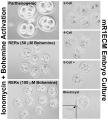
Reconstructed early rat embryos
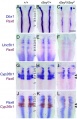
Rat hindbrain E11.5, down-regulated genes and Pax6
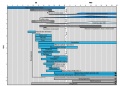
Rat thyroid system and neural development


Historic Images
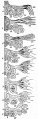
Bailey Fig. 6. Schematic outline of spermatogenesis in the rat
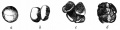
Bailey Fig. 53. Four stages in the cleavage of the ovum of the white rat
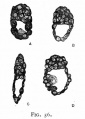
Bailey Fig. 56. Sections of blastocysts of the white rat, 5 days after insemination
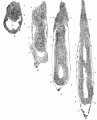
Bailey Fig. 61. Sections of blastocysts of the white rat
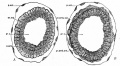
Bailey Fig. 62. Cross sections of an egg-cylinder of the white rat, 8 days and 17 hours after insemination
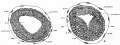
Bailey Fig. 63 Cross sections of egg-cylinders of the white rat
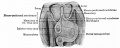
Bailey Fig. 295. Ventral view of parts of the lungs, pleural cavities, peritoneal cavity, and the pleuro-peritoneal membranes in a rat embryo


External Links
External Links Notice - The dynamic nature of the internet may mean that some of these listed links may no longer function. If the link no longer works search the web with the link text or name. Links to any external commercial sites are provided for information purposes only and should never be considered an endorsement. UNSW Embryology is provided as an educational resource with no clinical information or commercial affiliation.
- Rat Genome Database RGD <pubmed>17151068</pubmed>
| Animal Development: axolotl | bat | cat | chicken | cow | dog | dolphin | echidna | fly | frog | goat | grasshopper | guinea pig | hamster | horse | kangaroo | koala | lizard | medaka | mouse | opossum | pig | platypus | rabbit | rat | salamander | sea squirt | sea urchin | sheep | worm | zebrafish | life cycles | development timetable | development models | K12 |
Glossary Links
- Glossary: A | B | C | D | E | F | G | H | I | J | K | L | M | N | O | P | Q | R | S | T | U | V | W | X | Y | Z | Numbers | Symbols | Term Link
Cite this page: Hill, M.A. (2026, September 16) Embryology Rat Development. Retrieved from https://embryology.med.unsw.edu.au/embryology/index.php/Rat_Development
- © Dr Mark Hill 2026, UNSW Embryology ISBN: 978 0 7334 2609 4 - UNSW CRICOS Provider Code No. 00098G
