Lecture - 2014 Course Introduction: Difference between revisions
mNo edit summary |
mNo edit summary |
||
| Line 82: | Line 82: | ||
[[Carnegie Collection]] | [[Carnegie Collection]] | ||
| colspan=2|[[File:Human Carnegie stage 10-23.jpg|400px]] | | colspan=2|[[File:Human Carnegie stage 10-23.jpg|400px]] | ||
|- | |- | ||
Begun by Dr. Hideo Nishimura (1912–1995) | | Begun by Dr. Hideo Nishimura (1912–1995) | ||
[[File:Shiota_Hill_Yamada.jpg|200px]] | [[File:Shiota_Hill_Yamada.jpg|200px]] | ||
| Line 93: | Line 94: | ||
|} | |} | ||
{| class="wikitable mw-collapsible mw-collapsed" | |||
! [[Animal_Development|Animal Models]] | |||
|- | |||
| [[File:Frog-icon.png|right|80px|link=Frog Development]] | |||
| {{Frog links}} | |||
* The frog was used by many of the early embryology investigators and currently there are many different molecular mechanisms concerning development of the frog. | |||
* The eggs develop independently, in relative synchrony and are relatively see-through making staging and observation fairly easy. | |||
* The frog was a key model for the study of the process of gastrulation. | |||
|- | |||
| [[File:Chick icon.jpg|80px|link=Chicken Development]] | |||
| | |||
{{Chicken}} | |||
* The chicken embryo develops and hatches in 20-21 days and historically these were one of the first embryos to be studied. Cutting a window in the egg shell allows direct observation of the embryo. The Hamburger & Hamilton chicken development staging allowed researchers to develop this model as a key embryological tool. | |||
* Key research involved the transplanting of quail cells into chick embryos, to later identify their contribution to different embryonic structures, particularly for somite, neural tube and neural crest development. | |||
|- | |||
| [[File:Mouse.jpg|right|80px|link=Mouse Development]] | |||
| {{Mouse}} | |||
* The mouse has always been a good embryological model, easy to generate (litters 8-20) and quick (21d). | |||
* Mouse embryology really expanded when molecular biologists used mice for gene knockouts. | |||
|- | |||
| [[File:Fly-icon.png|right|80px|link=Fly Development]] | |||
| [[Fly Development|Fly Development]] - The fruitfly (drosophila) was and is the traditional geneticist's tool. It has been transformed to an magnificent embryologist's tool, with developmental mechanisms being uncovered in this system combined with homolgy gene searches in other species. The fly genome was one of the first to be been completely sequenced. In early development nurse cells ''sacrifice'' their cytoplasmic contents to allow egg growth and early pattern formation is through the localization of maternal messenger RNAs (mRNAs). | |||
|- | |||
| | [[File:C elegans.jpg|right|80px|link=Worm Development]] | |||
| [[Worm Development|Worm Development]] - Early embryological studies of the worm ''Caenorhabditis elegans'' (C.Elegans, so called because of its "elegant" curving movement) characterized the fate of each and every cell in the worm through all stages of development. This worm has recently had its entire genome sequenced. | |||
|- | |||
| [[File:Zebrafish-icon.png|right|80px|link=Zebrafish Development]] | |||
| [[Zebrafish Development|Zebrafish Development]] - Zebrafish are seen as the latest and greatest "model' for embryological development studies. They can be easily genetically altered and develop as practically "see through" embryos, all internal development can be clearly observed from the outside in the living embryo. | |||
|} | |||
Revision as of 18:08, 2 August 2014
Course Introduction

Course coordinator |
This first lecture will be a general introduction to the course and the subject of Embryology.
|
Objectives
| <html5media height="384" width="352">File:Human development 001.mp4</html5media> |
|
ANAT2341 Course Outline
I will spend the first half going through the current course design, online support and assessment criteria. This is an opportunity to ask the coordinator questions about the course.
Course Links: Homepage | Overview | Timetable | Moodle
Email me for any additional information or to make an appointment.
Textbooks
- Either of the textbooks listed below are recommended for this course and page references to both are given in each lecture.
- Both textbooks available at campus bookshop and online to UNSW students.
- There are additional embryology textbooks that can also be used, consult course organizer.
| The Developing Human: Clinically Oriented Embryology (10th edn) |
|---|
 UNSW Students have online access to the current 10th edn. through the UNSW Library subscription (with student Zpass log-in).
|
|
History
History - Embryologists | Embryology History | Human Embryo Collections

Braune - The Position of the Uterus and Fetus at Term (1872)]]
| Human Embryo Collections | ||
|---|---|---|

Wilhelm His (1831-1904) His's Normentafel (Normal Table) |

|

|

Franz Keibel (1861 - 1929) Franz Keibel and Curt Elze (1908) Normal Plates of the Development of the Human Embryo |

|

|

Franklin Mall (1862-1917) |

| |
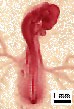
| Begun by Dr. Hideo Nishimura (1912–1995)
|

| |

| Animal Models | |
|---|---|
 |
|
|
|
 |
mouse
|
 |
Fly Development - The fruitfly (drosophila) was and is the traditional geneticist's tool. It has been transformed to an magnificent embryologist's tool, with developmental mechanisms being uncovered in this system combined with homolgy gene searches in other species. The fly genome was one of the first to be been completely sequenced. In early development nurse cells sacrifice their cytoplasmic contents to allow egg growth and early pattern formation is through the localization of maternal messenger RNAs (mRNAs). |
 |
Worm Development - Early embryological studies of the worm Caenorhabditis elegans (C.Elegans, so called because of its "elegant" curving movement) characterized the fate of each and every cell in the worm through all stages of development. This worm has recently had its entire genome sequenced. |
 |
Zebrafish Development - Zebrafish are seen as the latest and greatest "model' for embryological development studies. They can be easily genetically altered and develop as practically "see through" embryos, all internal development can be clearly observed from the outside in the living embryo. |
Australian Data
1 August 2014 at 03:53:30 PM (Canberra time), the resident population of Australia is projected to be: 23,550,233.

| Australian Statistics | |
|---|---|
|

|
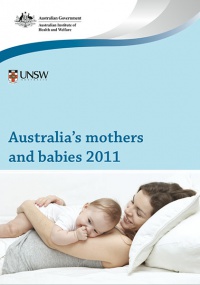
| Australia’s mothers and babies (2011) | Assisted reproductive technology in Australia and New Zealand (2010) |
| Average maternal age in 2011 was 30.0 years, the same as 2009 but still more than the earlier years (2000, 29.0 years; 2002, 29.4 years). | Assisted Reproductive Technology (ART) was used by 3.8% (2009, 3.6%) of women who gave birth. |
| Victoria - 10 most reported birth anomalies | ||||||||||||||||||||
|---|---|---|---|---|---|---|---|---|---|---|---|---|---|---|---|---|---|---|---|---|
| Based upon statistics from the Victorian Perinatal Data Collection Unit in Victoria between 2003-2004. | ||||||||||||||||||||
|


Human Development

- 2014 Course: Week 2 Lecture 1 Lecture 2 Lab 1 | Week 3 Lecture 3 Lecture 4 Lab 2 | Week 4 Lecture 5 Lecture 6 Lab 3 | Week 5 Lecture 7 Lecture 8 Lab 4 | Week 6 Lecture 9 Lecture 10 Lab 5 | Week 7 Lecture 11 Lecture 12 Lab 6 | Week 8 Lecture 13 Lecture 14 Lab 7 | Week 9 Lecture 15 Lecture 16 Lab 8 | Week 10 Lecture 17 Lecture 18 Lab 9 | Week 11 Lecture 19 Lecture 20 Lab 10 | Week 12 Lecture 21 Lecture 22 Lab 11 | Week 13 Lecture 23 Lecture 24 Lab 12
Student Projects - Group 1 | Group 2 | Group 3 | Group 4 | Group 5 | Group 6 | Group 7 | Group 8 | Moodle
Glossary Links
- Glossary: A | B | C | D | E | F | G | H | I | J | K | L | M | N | O | P | Q | R | S | T | U | V | W | X | Y | Z | Numbers | Symbols | Term Link
Cite this page: Hill, M.A. (2026, October 20) Embryology Lecture - 2014 Course Introduction. Retrieved from https://embryology.med.unsw.edu.au/embryology/index.php/Lecture_-_2014_Course_Introduction
- © Dr Mark Hill 2026, UNSW Embryology ISBN: 978 0 7334 2609 4 - UNSW CRICOS Provider Code No. 00098G

