Urinary Bladder Development: Difference between revisions
mNo edit summary |
mNo edit summary |
||
| Line 3: | Line 3: | ||
[[File:Adult urinary bladder.jpg|thumb|alt=Adult urinary bladder|Adult male and female urinary bladder]] | [[File:Adult urinary bladder.jpg|thumb|alt=Adult urinary bladder|Adult male and female urinary bladder]] | ||
[[File:Gray1140.jpg|thumb|300px|alt=Interior of the urinary bladder|Interior of the urinary bladder]] | [[File:Gray1140.jpg|thumb|300px|alt=Interior of the urinary bladder|Interior of the urinary bladder]] | ||
The paired adult kidneys filter blood, reabsorb water, have endocrine functions and excrete waste. The waste in the form of urine for excretion, collects initially in the renal pelvis and flows through the ureters to the urinary bladder. The wall of the urinary bladder is composed of layers of smooth muscle and in the male has close anatomical relationship with the prostate gland. (More? | The paired adult kidneys filter blood, reabsorb water, have endocrine functions and excrete waste. The waste in the form of urine for excretion, collects initially in the renal pelvis and flows through the ureters to the {{urinary bladder}}. The wall of the urinary bladder is composed of layers of smooth muscle and in the male has close anatomical relationship with the prostate gland. (More? {{Prostate}}) | ||
Abnormalities in renal development can lead to ureter obstruction and interfere with flow of urine to the bladder during the fetal period. | Abnormalities in renal development can lead to ureter obstruction and interfere with flow of urine to the bladder during the fetal period. | ||
| Line 15: | Line 15: | ||
{{Renal Links}} | {{Renal Links}} | ||
'''Historic Bladder:''' [[Book_-_Manual_of_Human_Embryology_19-1#Cloaca.2C_Bladder.2C_Urethra.2C_and_Urogenital_Sinus|1912 Cloaca, Bladder, Urethra, and Urogenital Sinus]] | [[Book_-_Text-Book_of_Embryology_15#The_Urinary_Bladder.2C_Urethra_and_Urogenital_Sinus|1921 Urinary Bladder]] | ::'''Historic Bladder:''' [[Book_-_Manual_of_Human_Embryology_19-1#Cloaca.2C_Bladder.2C_Urethra.2C_and_Urogenital_Sinus|1912 Cloaca, Bladder, Urethra, and Urogenital Sinus]] | [[Book_-_Text-Book_of_Embryology_15#The_Urinary_Bladder.2C_Urethra_and_Urogenital_Sinus|1921 Urinary Bladder]] | ||
==Some Recent Findings== | ==Some Recent Findings== | ||
| Line 60: | Line 60: | ||
| [[File:Endoderm_002_icon.jpg|200px|link=Development_Animation_-_Endoderm]] | | [[File:Endoderm_002_icon.jpg|200px|link=Development_Animation_-_Endoderm]] | ||
Animation - Endoderm forming the cloaca and the primitive urinary bladder continuous with the allantois. | Animation - Endoderm forming the {{cloaca}} and the primitive urinary bladder continuous with the allantois. | ||
|} | |} | ||
| Line 80: | Line 80: | ||
{{Urogenital septum movie}} | {{Urogenital septum movie}} | ||
:'''Links:''' {{cloaca}} | |||
==Embryonic Urinary Bladder== | ==Embryonic Urinary Bladder== | ||
[[File:Adult_bladder.jpg|thumb|Adult bladder]] | [[File:Adult_bladder.jpg|thumb|Adult bladder]] | ||
| Line 109: | Line 109: | ||
** internal layer - fibres arranged longitudinally | ** internal layer - fibres arranged longitudinally | ||
:'''Links:''' {{smooth muscle}} | |||
===Ureter Development=== | ===Ureter Development=== | ||
* The adult ureter is a thick-walled muscular tube, 25 - 30 cm in length, running from the kidney to the urinary bladder. | * The adult ureter is a thick-walled muscular tube, 25 - 30 cm in length, running from the kidney to the urinary bladder. | ||
| Line 120: | Line 121: | ||
==Week 8== | ==Week 8== | ||
The Carnegie stage | The Carnegie stage {{CS22}} human male embryo is 27mm (CRL) in size and approximately equal to day 54 - 56 of development. These images have been selected to show some key features of late embryo development. | ||
{| | {| | ||
| Line 205: | Line 206: | ||
:'''Links:''' [[Magnetic Resonance Imaging]] | :'''Links:''' [[Magnetic Resonance Imaging]] | ||
|} | |} | ||
===Urorectal Septum Malformation=== | ===Urorectal Septum Malformation=== | ||
| Line 223: | Line 216: | ||
===Bladder Exstrophy=== | ===Bladder Exstrophy=== | ||
[[File:Bladder_Exstrophy.jpg|thumb|Bladder_Exstrophy]] | [[File:Bladder_Exstrophy.jpg|thumb|Bladder_Exstrophy]] | ||
{{ICD-11} [https://icd.who.int/browse11/l-m/en#/http://id.who.int/icd/entity/1927556258 LB31.3 Exstrophy of urinary bladder] - Bladder exstrophy (or classic bladder exstrophy) is a congenital genitourinary malformation belonging to the spectrum of the exstrophy-epispadias complex and is characterized by an evaginated bladder plate, epispadias and an anterior defect of the pelvis, pelvic floor and abdominal wall. | |||
* developmental abnormality associated with bladder development. | * developmental abnormality associated with bladder development. | ||
* origins appear to occur not just by abnormal bladder development, but by a congenital malformation of the ventral wall of abdomen (between umbilicus and pubic symphysis). | * origins appear to occur not just by abnormal bladder development, but by a congenital malformation of the ventral wall of abdomen (between umbilicus and pubic symphysis). | ||
| Line 241: | Line 238: | ||
* mainly male | * mainly male | ||
* fetal urinary system ruptures leading to collapse and "prune belly" appearance. | * fetal urinary system ruptures leading to collapse and "prune belly" appearance. | ||
===Horseshoe Kidney=== | |||
[[File:Horseshoe kidney.jpg|thumb|Horseshoe kidney]] | |||
* fusion of the lower poles of the kidney. | |||
* During migration from the sacral region the two metanephric blastemas can come into contact, mainly at the lower pole. | |||
* The ureters pass in front of the zone of fusion of the kidneys. | |||
* The kidneys and ureters usually function adequately but there is an increased incidence of upper urinary tract obstruction or infection. | |||
* Some horseshoe variations have been described as having associated ureter abnormalities including duplications. | |||
==Stage 22== | ==Stage 22== | ||
[[File:Stage 22 image 210.jpg|600px]] | [[File:Stage 22 image 210.jpg|600px]] | ||
== References == | |||
<references/> | |||
===Reviews=== | |||
{{#pmid:19461520}} | |||
{{#pmid:17442697}} | |||
{{#pmid:16916378}} | |||
'''Search Bookshelf''' [http://www.ncbi.nlm.nih.gov/sites/entrez?db=Books&cmd=search&term=bladder%20development bladder development] | [http://www.ncbi.nlm.nih.gov/sites/entrez?db=Books&cmd=search&term=trigone%20development trigone development] [http://www.ncbi.nlm.nih.gov/sites/entrez?db=Books&cmd=search&term=ureter%20development ureter development] | |||
===Articles=== | |||
{{#pmid:17881488}} | |||
===Search PubMed=== | |||
'''Search Pubmed:''' [http://www.ncbi.nlm.nih.gov/sites/entrez?db=pubmed&cmd=search&term=urinary%20bladder%20development urinary bladder development] | [http://www.ncbi.nlm.nih.gov/sites/entrez?db=pubmed&cmd=search&term=bladder%20development bladder development] | |||
==Images== | ==Images== | ||
<gallery> | <gallery> | ||
File:Endoderm cartoon.jpg|Endoderm cartoon | File:Endoderm cartoon.jpg|Endoderm cartoon | ||
File:Fetal 10wk urogenital 1.jpg|Fetal urogenital region most lateral right | File:Fetal 10wk urogenital 1.jpg|Fetal urogenital region most lateral right | ||
| Line 267: | Line 293: | ||
===Historic Images=== | ===Historic Images=== | ||
{{Historic Disclaimer}} | |||
<gallery> | |||
File:Stage 11 historic-Atwell1930-3b.jpg|Stage 11 historic Atwell (1930) | |||
File:Stage_11_historic-Heuser1930-1c.jpg|Stage 11 historic Heuser (1930) | |||
File:Gray1126.png|retroperitoneal | |||
File:Gray1139.jpg|Fig. 1139 Adult Female Bladder | |||
</gallery> | |||
{{Ref-Bailey1921}} | |||
[[Book_-_Text-Book_of_Embryology_(1921)|Text-Book of Embryology]]. Bailey, F.R. and Miller, A.M. (1921). New York: William Wood and Co. [[Book_-_Text-Book_of_Embryology_15#The_Urinary_Bladder.2C_Urethra_and_Urogenital_Sinus|The Urinary Bladder]] | [[Book_-_Text-Book_of_Embryology_(1921)|Text-Book of Embryology]]. Bailey, F.R. and Miller, A.M. (1921). New York: William Wood and Co. [[Book_-_Text-Book_of_Embryology_15#The_Urinary_Bladder.2C_Urethra_and_Urogenital_Sinus|The Urinary Bladder]] | ||
<gallery> | <gallery> | ||
| Line 275: | Line 312: | ||
</gallery> | </gallery> | ||
{{Ref-Keith1902}} [[Book - Human Embryology and Morphology 9|The Uro-genital System]] | |||
<gallery> | <gallery> | ||
File:Keith1902 fig099.jpg|Fig. 99. A section of the male bladder and urethra at birth | File:Keith1902 fig099.jpg|Fig. 99. A section of the male bladder and urethra at birth | ||
</gallery> | </gallery> | ||
== Terms == | == Terms == | ||
Revision as of 15:40, 14 November 2018
Embryology - 13 Mar 2026    Expand to Translate Expand to Translate
|
|---|
| Google Translate - select your language from the list shown below (this will open a new external page) |
|
العربية | català | 中文 | 中國傳統的 | français | Deutsche | עִברִית | हिंदी | bahasa Indonesia | italiano | 日本語 | 한국어 | မြန်မာ | Pilipino | Polskie | português | ਪੰਜਾਬੀ ਦੇ | Română | русский | Español | Swahili | Svensk | ไทย | Türkçe | اردو | ייִדיש | Tiếng Việt These external translations are automated and may not be accurate. (More? About Translations) |
Introduction


The paired adult kidneys filter blood, reabsorb water, have endocrine functions and excrete waste. The waste in the form of urine for excretion, collects initially in the renal pelvis and flows through the ureters to the urinary bladder. The wall of the urinary bladder is composed of layers of smooth muscle and in the male has close anatomical relationship with the prostate gland. (More? prostate)
Abnormalities in renal development can lead to ureter obstruction and interfere with flow of urine to the bladder during the fetal period.
- Historic Bladder: 1912 Cloaca, Bladder, Urethra, and Urogenital Sinus | 1921 Urinary Bladder
Some Recent Findings

|
| More recent papers |
|---|
  This table allows an automated computer search of the external PubMed database using the listed "Search term" text link.
More? References | Discussion Page | Journal Searches | 2019 References | 2020 References Search term: Bladder Embryology <pubmed limit=5>Bladder Embryology</pubmed> |
Textbook References
- The Developing Human: Clinically Oriented Embryology (8th Edition) by Keith L. Moore and T.V.N Persaud - Moore & Persaud Chapter 13 p303-346
- Larsen’s Human Embryology by GC. Schoenwolf, SB. Bleyl, PR. Brauer and PH. Francis-West - Chapter 10 p261-306
Movies
|
|
|
|
|
|
|
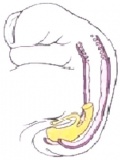

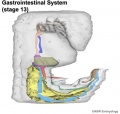
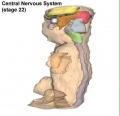
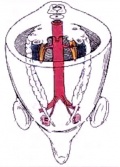
Renal System Development | All Renal Cartoons
Cloaca

|
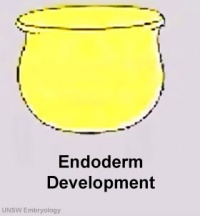
Animation - Endoderm forming the cloaca and the primitive urinary bladder continuous with the allantois. |
- hindgut region ending at the cloacal membrane
- divided (ventro-dorsally) by the urogenital septum
- ventral - common urogenital sinus
- dorsal - rectum
Common Urogenital Sinus
- superior end continuous with allantois
- common urogenital sinus and mesonephric duct fuse (connect)
- differentiates to form the bladder
- inferior end forms urethra
- this will be different in male and female development
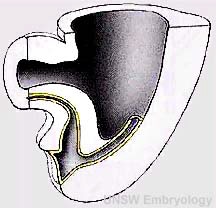
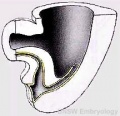
Urogenital Septum
|
| Urogenital Septum |
| Page | Play |
- Links: cloaca
Embryonic Urinary Bladder

- early origins of the bladder at the superior end of the common urogenital sinus
- 8 open inferiorly to the cloaca and superiorly to the allantois
- Septation of the claoca - divides the anterior region to the primordial bladder component from the posterior rectal component.
- associated ureters and urethra
Dorsal view of developing bladder
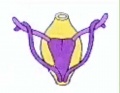
|
| Trigone |
| Page | Play |
- Ultrasound measurement of the bladder size can be used as a diagnostic tool for developmental abnormalities.
Bladder Structure

Can be described anatomically by its 4 layers from outside inward:
- Serous - the superior or abdominal surfaces and the lateral" surfaces of the bladder are covered by visceral peritoneum, the serous membrane (serosa) of the abdominal cavity, consisting of mesthelium and elastic fibrous connective tissue.
- Muscular - the detrusor muscle is the muscle of the urinary bladder wall.
- Submucosa - connects the muscular layer with the mucous layer.
- Mucosa - (mucus layer) a transitional epithelium layer formed into folds (rugae).

Detrusor Muscle
- The adult detrusor muscle consists of three layers of smooth (involuntary) muscle fibres.
- external layer - fibres arranged longitudinally
- middle layer - fibres arranged circularly
- internal layer - fibres arranged longitudinally
- Links: smooth muscle
Ureter Development
- The adult ureter is a thick-walled muscular tube, 25 - 30 cm in length, running from the kidney to the urinary bladder.
- Anatomically can be described in two parts the abdominal part (pars abdominalis) and pelvic part (pars pelvina).
- The ureter is composed of three layers: outer fibrous layer (tunica adventitia), muscular layer (tunica muscularis) and mucous layer (tunica mucosa).
- The muscular layer can also be subdivided into 3 fibre layers: an external longitudinal, a middle circular, and an internal longitudinal.
Trigone Development
|
|
| Trigone |
| Page | Play |
Week 8
The Carnegie stage 22 human male embryo is 27mm (CRL) in size and approximately equal to day 54 - 56 of development. These images have been selected to show some key features of late embryo development.

|

|

|

|

|
| G5 urogenital | G6 urogenital | G7 urogenital | unlabeled | labeled |
Fetal Urinary Bladder
Fetal Development - 10 Weeks - Early female fetal bladder development. Anatomically lying behind the pubic symphysis and in front of the developing uterus. Surrounded by the developing detrusor muscle and the superior end extending towards the ventral body wall herniation.

|

|
| midline section | medial section |
- Links: Fetal Development - 10 Weeks

|
MRI appearance of normal fetal kidney.[4] Sagittal T2- SSFSE of a fetal abdomen at GA 25 week. Adequate volume of the amniotic fluid and the developing lungs indicate good renal function.
Note that the urinary bladder can occupy a considerable portion of the abdomen as a normal finding.
|
Newborn Urinary Bladder

|

|
| The Newborn Male Bladder | The Newborn Female Bladder |
Animal Models
 Mouse bladder development E12.5-E16.5[2]
Abnormalities

Duplicated Bladder

|
Urinary bladder duplication is an extremely rare abnormality.[5]
This MRI of a male newborn infant shows the duplicated bladder and also duplicated external genitalia (phallus).
|
Urorectal Septum Malformation
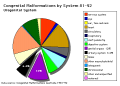
- thought to be a deficiency in caudal mesoderm which in turn leads to the malformation of the urorectal septum and other structures in the pelvic region.
- Recent research has also identified the potential presence of a persistent urachus prior to septation of the cloaca (common urogenital sinus).
Bladder
- absent or small bladder - associated with renal agenesis.
Bladder Exstrophy

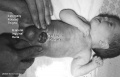
{{ICD-11} LB31.3 Exstrophy of urinary bladder - Bladder exstrophy (or classic bladder exstrophy) is a congenital genitourinary malformation belonging to the spectrum of the exstrophy-epispadias complex and is characterized by an evaginated bladder plate, epispadias and an anterior defect of the pelvis, pelvic floor and abdominal wall.
- developmental abnormality associated with bladder development.
- origins appear to occur not just by abnormal bladder development, but by a congenital malformation of the ventral wall of abdomen (between umbilicus and pubic symphysis).
- There may also be other anomolies associated with failure of closure of abdominal wall and bladder (epispadias, pubic bone anomolies).
Ureter and Urethra
- Ureter - Duplex Ureter
- Urethra- Urethral Obstruction and Hypospadias
Prune Belly Syndrome
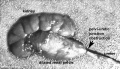
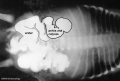

Prune_belly


- lower urinary tract obstruction
- mainly male
- fetal urinary system ruptures leading to collapse and "prune belly" appearance.
Horseshoe Kidney

- fusion of the lower poles of the kidney.
- During migration from the sacral region the two metanephric blastemas can come into contact, mainly at the lower pole.
- The ureters pass in front of the zone of fusion of the kidneys.
- The kidneys and ureters usually function adequately but there is an increased incidence of upper urinary tract obstruction or infection.
- Some horseshoe variations have been described as having associated ureter abnormalities including duplications.
Stage 22

References
- ↑ Favorito LA, Pazos HM, Costa SF, Costa WS & Sampaio FJ. (2014). Morphology of the fetal bladder during the second trimester: comparing genders. J Pediatr Urol , 10, 1014-9. PMID: 25434295 DOI.
- ↑ 2.0 2.1 Islam SS, Mokhtari RB, Kumar S, Maalouf J, Arab S, Yeger H & Farhat WA. (2013). Spatio-temporal distribution of Smads and role of Smads/TGF-β/BMP-4 in the regulation of mouse bladder organogenesis. PLoS ONE , 8, e61340. PMID: 23620745 DOI.
- ↑ Tanaka ST, Ishii K, Demarco RT, Pope JC, Brock JW & Hayward SW. (2010). Endodermal origin of bladder trigone inferred from mesenchymal-epithelial interaction. J. Urol. , 183, 386-91. PMID: 19914648 DOI.
- ↑ Saleem SN. (2014). Fetal MRI: An approach to practice: A review. J Adv Res , 5, 507-23. PMID: 25685519 DOI.
- ↑ Gajbhiye V, Nath S, Ghosh P, Chatterjee A, Haldar D & Das SK. (2015). Complete duplication of the urinary bladder: An extremely rare congenital anomaly. Urol Ann , 7, 91-3. PMID: 25657554 DOI.
Reviews
Shapiro E. (2009). Clinical implications of genitourinary embryology. Curr Opin Urol , 19, 427-33. PMID: 19461520 DOI.
Brenner-Anantharam A, Cebrian C, Guillaume R, Hurtado R, Sun TT & Herzlinger D. (2007). Tailbud-derived mesenchyme promotes urinary tract segmentation via BMP4 signaling. Development , 134, 1967-75. PMID: 17442697 DOI.
Costantini F. (2006). Renal branching morphogenesis: concepts, questions, and recent advances. Differentiation , 74, 402-21. PMID: 16916378 DOI.
Search Bookshelf bladder development | trigone development ureter development
Articles
Viana R, Batourina E, Huang H, Dressler GR, Kobayashi A, Behringer RR, Shapiro E, Hensle T, Lambert S & Mendelsohn C. (2007). The development of the bladder trigone, the center of the anti-reflux mechanism. Development , 134, 3763-9. PMID: 17881488 DOI.
Search PubMed
Search Pubmed: urinary bladder development | bladder development
Images
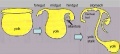
Endoderm cartoon
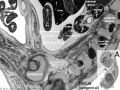
Fetal urogenital region most lateral right
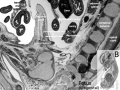
Fetal urogenital region lateral right
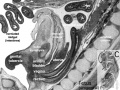
Fetal urogenital region medial
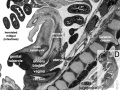
Fetal urogenital region midline
Fetal kidney (10 weeks)
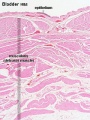
Bladder histology
Prune belly
Renal outflow obstruction
Bladder Exstrophy


Historic Images
| Historic Disclaimer - information about historic embryology pages |
|---|
|
Stage 11 historic Atwell (1930)
Stage 11 historic Heuser (1930)
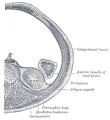
retroperitoneal
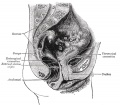
Fig. 1139 Adult Female Bladder


Bailey FR. and Miller AM. Text-Book of Embryology (1921) New York: William Wood and Co.
Text-Book of Embryology. Bailey, F.R. and Miller, A.M. (1921). New York: William Wood and Co. The Urinary Bladder
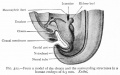
Cloaca and surrounding structures human embryo of 6.5 mm
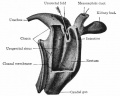
Cloacal region human embryo
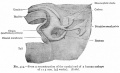
Caudal end human embryo of 11.5 mm
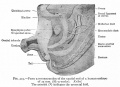
Caudal end human embryo of 25 mm


Keith A. Human Embryology and Morphology. (1902) London: Edward Arnold. The Uro-genital System
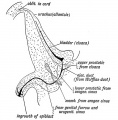
Fig. 99. A section of the male bladder and urethra at birth

Terms
- bladder exstrophy - A congenital malformation with bladder open to ventral wall of abdomen (between umbilicus and pubic symphysis) and may have other anomolies associated with failure of closure of abdominal wall and bladder (epispadias, pubic bone anomolies).
- hydronephrosis - (congenital hydronephrosis, Greek, hydro = water) A kidney abnormality due to partial or complete obstruction at the pelvi-ureteric junction. This leads to a grossly dilated renal pelvis causing extensive renal damage before birth.
- mesonephric duct - (= Wollfian duct) An early developing urogenital duct running the length of the embryo that will differentiate and form the male reproductive duct system. In females this duct degenerates (some remnants may remain associated in broad ligament).
- proteinuria - The abnormal presence of protein in the urine and an indicator of diesease including diabetic kidney disease (DKD, diabetic nephropathy).
- renal - (Latin, renes = kidney) Term used in relation to the kidney and associated structures (renal pelvis, renal artery)
- ureter - The two ureters are hollow tubes that link and carries urine from kidney to the bladder. The tubes have a muscular wall lined with transitional epithelium.
- urethra - The single muscular tube that links and carries urine from the bladder to the exterior. In humans, the urethral length differs between the sexes (male longer, female shorter).
- urinary - Term used to describe all components of the kidney system including the bladder, ureters and urethra.
- urine - Term used to describe the liquid waste produced by the kidney, stored in the bladder and excreted from teh body through the urethra.
- urorectal septum - (URS) The structure which develops to separate the cloaca (common urogenital sinus) into an anterior urinary part and a posterior rectal part.
- Wolffian duct - (= mesonephric duct, preferred terminology), runs from the mesonephros to cloaca, differentiates to form the male vas deferens and in the female regresses. Named after Caspar Friedrich Wolff (1733-1794), a German scientist and early embryology researcher and is said to have established the doctrine of germ layers. (More? Caspar Friedrich Wolff)
Glossary Links
- Glossary: A | B | C | D | E | F | G | H | I | J | K | L | M | N | O | P | Q | R | S | T | U | V | W | X | Y | Z | Numbers | Symbols | Term Link
Cite this page: Hill, M.A. (2026, March 13) Embryology Urinary Bladder Development. Retrieved from https://embryology.med.unsw.edu.au/embryology/index.php/Urinary_Bladder_Development
- © Dr Mark Hill 2026, UNSW Embryology ISBN: 978 0 7334 2609 4 - UNSW CRICOS Provider Code No. 00098G
