Gastrointestinal Tract - Gall Bladder Development: Difference between revisions
No edit summary |
|||
| Line 67: | Line 67: | ||
'''Search Pubmed Now:''' [http://www.ncbi.nlm.nih.gov/sites/entrez?db=pubmed&cmd=search&term=Gall%20Bladder%20Development Gall Bladder Development] | '''Search Pubmed Now:''' [http://www.ncbi.nlm.nih.gov/sites/entrez?db=pubmed&cmd=search&term=Gall%20Bladder%20Development Gall Bladder Development] | | ||
[http://www.ncbi.nlm.nih.gov/sites/entrez?db=pubmed&cmd=search&term=Cholangiocyte%20Development Cholangiocyte Development] | | |||
{{Template:Glossary}} | {{Template:Glossary}} | ||
Revision as of 16:42, 22 August 2011
Introduction

This section of notes gives an overview of Gall Bladder and hillary tree development, histology and abnormalities associated with the biliary system. In the adult, the gall bladder is a site of bile salt storage and concentration, to then be released into the duodenum where they act to solubilize dietary lipids by their detergent effect. Bile salts are a cholesterol derivative (breakdown product).
The transverse septum differentiates to form the hepatic diverticulum and the hepatic primordium, these two structures together will go on to form different components of the mature liver and gall bladder.
The hepatic diverticulum divides into two parts: pars hepatica (larger cranial part, primordium of the liver) and pars cystica (smaller ventral invagination, primordium of gall bladder).
The pars cystica vacuolates and expands, the stalk becoming the cystic duct. This structure is initially hollow, then solid (by proliferation of epithelial lining), and then recanalized occurs by vacuolation of this expanded epithelium. There are several opinions as to whether the duct has a solid phase or remains patent throughout development.[1][2]
See also Gall Bladder Histology.
| Gall Bladder Histology | original page
Some Recent Findings
|
Embryonic Development

Early embryonic gall bladder (Carnegie stage 13, Week 4)

Late embryonic gall bladder (Carnegie stage 22, Week 8)
Additional Images
See also Gall Bladder Histology
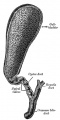
Historic drawing gall bladder anatomy
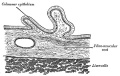
Historic drawing gall bladder transverse section
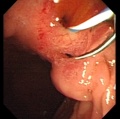
Abnormality - ectopic opening of the common bile duct (CBD) into the duodenal bulb.


References
Reviews
<pubmed>20551648</pubmed> <pubmed>20152372</pubmed> <pubmed>15853977</pubmed> <pubmed>15382016</pubmed>
Articles
<pubmed>21078254</pubmed> <pubmed>20191134</pubmed> <pubmed>16273658</pubmed>
Search Pubmed
July 2010
Search Bookshelf Gall Bladder Development
Search Pubmed Now: Gall Bladder Development |
Cholangiocyte Development |
Glossary Links
- Glossary: A | B | C | D | E | F | G | H | I | J | K | L | M | N | O | P | Q | R | S | T | U | V | W | X | Y | Z | Numbers | Symbols | Term Link
Cite this page: Hill, M.A. (2026, September 14) Embryology Gastrointestinal Tract - Gall Bladder Development. Retrieved from https://embryology.med.unsw.edu.au/embryology/index.php/Gastrointestinal_Tract_-_Gall_Bladder_Development
- © Dr Mark Hill 2026, UNSW Embryology ISBN: 978 0 7334 2609 4 - UNSW CRICOS Provider Code No. 00098G
