Endocrine - Thymus Development: Difference between revisions
mNo edit summary |
mNo edit summary |
||
| Line 21: | Line 21: | ||
|-bgcolor="F5FAFF" | |-bgcolor="F5FAFF" | ||
| | | | ||
* '''What do we know about the structure of human thymic Hassall's corpuscles?''' <ref name=PMID28279759><pubmed>28279759</pubmed></ref> "Hassall's corpuscles are the most prominent structures in the human thymus. However, relatively few analyses have been performed to determine their function and cellular origins during development. In this study, we evaluated the cellular microenvironment of human thymic Hassall's corpuscles using histochemistry, immunohistochemistry, and transmission electron microscopy. ... Considerable variation in the sizes, shapes, and numbers of Hassall's corpuscles was observed, even amongst children of the same age. ... Immunohistochemical staining and electron microscopy revealed that Hassall's corpuscles resemble other types of stratified squamous epithelia." | |||
* '''Dynamics of thymus organogenesis and colonization in early human development'''<ref name=PMID23571219><pubmed>23571219</pubmed></ref> "The thymus is the central site of T-cell development and thus is of fundamental importance to the immune system, but little information exists regarding molecular regulation of thymus development in humans. ... In addition, we provide molecular evidence that the human thymic epithelium derives solely from the third pharyngeal pouch, as in the mouse, in contrast to previous suggestions." | * '''Dynamics of thymus organogenesis and colonization in early human development'''<ref name=PMID23571219><pubmed>23571219</pubmed></ref> "The thymus is the central site of T-cell development and thus is of fundamental importance to the immune system, but little information exists regarding molecular regulation of thymus development in humans. ... In addition, we provide molecular evidence that the human thymic epithelium derives solely from the third pharyngeal pouch, as in the mouse, in contrast to previous suggestions." | ||
* '''Thymus-associated parathyroid hormone has two cellular origins with distinct endocrine and immunological functions'''<ref name="PMID21203493"><pubmed>21203493</pubmed> | [http://www.plosgenetics.org/article/info%3Adoi%2F10.1371%2Fjournal.pgen.1001251 PLoS Genet.]</ref> "In mammals, parathyroid hormone (PTH) is a key regulator of extracellular calcium and inorganic phosphorus homeostasis. Although the parathyroid glands were thought to be the only source of PTH, extra-parathyroid PTH production in the thymus, which shares a common origin with parathyroids during organogenesis, has been proposed to provide an auxiliary source of PTH, resulting in a higher than expected survival rate for aparathyroid Gcm2⁻/⁻ mutants. However, the developmental ontogeny and cellular identity of these "thymic" PTH-expressing cells is unknown. ...Our data show conclusively that the thymus does not serve as an auxiliary source of either serum PTH or parathyroid function. We further show that the normal process of parathyroid organogenesis in both mice and humans leads to the generation of multiple small parathyroid clusters in addition to the main parathyroid glands, that are the likely source of physiologically relevant "thymic PTH."" [[Endocrine - Parathyroid Development]] | * '''Thymus-associated parathyroid hormone has two cellular origins with distinct endocrine and immunological functions'''<ref name="PMID21203493"><pubmed>21203493</pubmed> | [http://www.plosgenetics.org/article/info%3Adoi%2F10.1371%2Fjournal.pgen.1001251 PLoS Genet.]</ref> "In mammals, parathyroid hormone (PTH) is a key regulator of extracellular calcium and inorganic phosphorus homeostasis. Although the parathyroid glands were thought to be the only source of PTH, extra-parathyroid PTH production in the thymus, which shares a common origin with parathyroids during organogenesis, has been proposed to provide an auxiliary source of PTH, resulting in a higher than expected survival rate for aparathyroid Gcm2⁻/⁻ mutants. However, the developmental ontogeny and cellular identity of these "thymic" PTH-expressing cells is unknown. ...Our data show conclusively that the thymus does not serve as an auxiliary source of either serum PTH or parathyroid function. We further show that the normal process of parathyroid organogenesis in both mice and humans leads to the generation of multiple small parathyroid clusters in addition to the main parathyroid glands, that are the likely source of physiologically relevant "thymic PTH."" [[Endocrine - Parathyroid Development]] | ||
Revision as of 11:57, 23 Mayıs 2017
Embryology - 16 Oct 2026    Expand to Translate Expand to Translate
|
|---|
| Google Translate - select your language from the list shown below (this will open a new external page) |
|
العربية | català | 中文 | 中國傳統的 | français | Deutsche | עִברִית | हिंदी | bahasa Indonesia | italiano | 日本語 | 한국어 | မြန်မာ | Pilipino | Polskie | português | ਪੰਜਾਬੀ ਦੇ | Română | русский | Español | Swahili | Svensk | ไทย | Türkçe | اردو | ייִדיש | Tiếng Việt These external translations are automated and may not be accurate. (More? About Translations) |
Introduction

The thymus has two origins for the lymphoid thymocytes and the thymic epithelial cells. The thymic epithelium begins as two flask-shape endodermal diverticula that form from the third pharyngeal pouch and extend lateralward and backward into the surrounding mesoderm and neural crest-derived mesenchyme in front of the ventral aorta. The immune system T cells are essential for responses against infections and much research concerns the postnatal development of T cells within the thymus.
Stieda in 1881[1] was the first to observe that the thymus gland originated from a visceral (pharyngeal) pouch (endoderm).
This current page relates to the endocrine role of the thymus, for more detailed description of this organ development see Thymus Development.
| Immune Links: immune | blood | spleen | thymus | lymphatic | lymph node | Antibody | Med Lecture - Lymphatic Structure | Med Practical | Immune Movies | vaccination | bacterial infection | Abnormalities | Category:Immune | ||
|
Some Recent Findings

|
| More recent papers |
|---|
  This table allows an automated computer search of the external PubMed database using the listed "Search term" text link.
More? References | Discussion Page | Journal Searches | 2019 References | 2020 References Search term: Thymus Embryology <pubmed limit=5>Thymus Embryology</pubmed> |
Thymus Hormones
Thymus produces self-hormones
- thymulin
- thymosin
- thymopentin
- thymus humoral factor
Thymus Development


- Endoderm - third pharyngeal pouch
- Week 6 - diverticulum elongates, hollow then solid, ventral cell proliferation
- Thymic primordia - surrounded by neural crest mesenchyme, epithelia/mesenchyme interaction
- Thymus - bone-marrow lymphocyte precursors become thymocytes, and subsequently mature into T lymphocytes (T cells)
- Thymus hormones - thymosins stimulate the development and differentiation of T lymphocytes

|

|
| B2 Pharyngeal Arch Pouches 3 and 4 (stage 13) | D1 Developing Human Thymus (stage 22) |
Thymus Involution
A postnatal process defined as a decrease in the size, weight and activity of the gland with advancing age. In a recent review[6], thymic involution was described as a result of high levels of circulating sex hormones, in particular during puberty, and a lower population of precursor cells from the bone marrow and finally changes in the thymic microenvironment.
References
- ↑ Stieda L (1881) Untersuchungen über die Entwickelung der Glandular Thymus, Glandular Thyreoidea, und Glandular carotidica. Leipzig, Engelmann p38.
- ↑ 2.0 2.1 <pubmed>21203493</pubmed> | PLoS Genet.
- ↑ <pubmed>28279759</pubmed>
- ↑ <pubmed>23571219</pubmed>
- ↑ <pubmed>20644572</pubmed>
- ↑ <pubmed>20354268 </pubmed>
Reviews
<pubmed>19582736</pubmed> <pubmed>18304000</pubmed> <pubmed>17876091</pubmed> <pubmed>16448532</pubmed>
Articles
<pubmed>17625108</pubmed> <pubmed>15057786</pubmed> <pubmed>11742403</pubmed>
Search PubMed
Search Pubmed: thymus development
Additional Images
Historic Images
| Historic Disclaimer - information about historic embryology pages |
|---|
|
Sudler, MT. The Development of the Nose and of the Pharynx and its Derivatives in Man. (1902) Amer. J. Anat 1:391–416. Thymus Gland
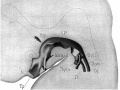
Fig. 8. Model of pharynx embryo CXLIV
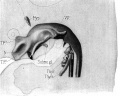
Fig. 9. Model of pharynx embryo XLIII
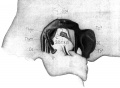
Fig. 10. Lateral view of embryo XXII


Adult Histology
Terms
- Hassall's corpuscle - thymic corpuscle.
- Thymic corpuscle (=Hassall's corpuscle) a mass of concentric epithelioreticular cells found in the thymus. The number present and size tend to increase with thymus age. (see classical description of Hammar, J. A. 1903 Zur Histogenese und Involution der Thymusdriise. Anat. Anz., 27: 1909 Fiinfzig Jahre Thymusforschung. Ergebn. Anat. Entwickl-gesch. 19: 1-274.)
- thymic epitheliocytes - reticular cells located in the thymus cortex that ensheathe the cortical capillaries, creating and maintain the microenvironment necessary for the development of T-lymphocytes in the cortex.
- T lymphocyte (cell) - named after thymus, where they develop, the active cell is responsible for cell-mediated immunity. (More? Electron micrographs of nonactivate and activated lymphocytes)
Glossary Links
- Glossary: A | B | C | D | E | F | G | H | I | J | K | L | M | N | O | P | Q | R | S | T | U | V | W | X | Y | Z | Numbers | Symbols | Term Link
Cite this page: Hill, M.A. (2026, October 16) Embryology Endocrine - Thymus Development. Retrieved from https://embryology.med.unsw.edu.au/embryology/index.php/Endocrine_-_Thymus_Development
- © Dr Mark Hill 2026, UNSW Embryology ISBN: 978 0 7334 2609 4 - UNSW CRICOS Provider Code No. 00098G
