2011 Lab 8 - Late Embryo: Difference between revisions
From Embryology
(Created page with "{{2011Lab8}} {{2011Lab8}} {{Glossary}} {{Footer}}") |
No edit summary |
||
| Line 1: | Line 1: | ||
{{2011Lab8}} | {{2011Lab8}} | ||
==Week 8== | |||
{| | |||
| | |||
<wikiflv width="560" height="588" autoplay="true" position="left">Stage22_urogenlarge.flv|File:Stage22-UG-icon.jpg</wikiflv> | |||
(Carnegie stage 22, male) [[Quicktime_Movie_-_Urogenital_System_3D_stage_22|Quicktime]] | |||
| valign="top" | '''Begin by observing the internal structure of the embryo at the end of week 8.''' | |||
'''Colour code:''' | |||
* <font color=chocolate>'''Adrenal Glands'''</font> (brown - fetal adrenal cortex and neural crest medulla) | |||
* <font color=coral>'''Kidneys'''</font> (orange - metanephros) | |||
* <font color=limegreen>'''Gonads'''</font> (green - developing testes) | |||
* <font color=red>'''Urinary Bladder'''</font> (red - urogenital sinus) | |||
* <font color=gold>'''Urethra'''</font> (yellow - urethra) | |||
* This page shows selected excerpts from whole cross-sections of the human embryo (week 8, stage 22) late embryonic period. | |||
* Read the description with the serial section excerpt and then use the link below each image (click section number) to see the full cross-section image. | |||
* They are organised in sequence as if you were travelling downward through the embryo (that is why the kidney comes first). | |||
|} | |||
===Embryo (week 8, Stage 22) Renal=== | |||
{| class="prettytable" | |||
|[[File:Stage_22 image 083.jpg|160px]] | |||
E6: R,L adrenal glands under diaphragm. | |||
[[File:Stage_22 image 084.jpg|160px]] | |||
E7: Large adrenal glands. Inferior vena cava. Thoracic aorta. | |||
| [[File:Stage_22 image 085.jpg|160px]] | |||
| [[File:Stage_22 image 086.jpg|160px]] | |||
| [[File:Stage_22 image 087.jpg|160px]] | |||
|- | |||
| | |||
| F1: Adrenal glands. R. Kidney. Autonomic ganglia (partly the adrenal medulla precursors). | |||
| F2: Kidneys (note retroperitoneal location). Cortex. Medulla. L. Adrenal gland. Superior mesenteric artery. Inferior vena cava. | |||
| F3: R testis (note its location relative to the R adrenal). L adrenal. R renal hilus. large channels are branches of ureteric tree. | |||
|- | |||
| [[File:Stage_22 image 088.jpg|160px]] | |||
| [[File:Stage_22 image 089.jpg|160px]] | |||
| [[File:Stage_22 image 090.jpg|160px]] | |||
| [[File:Stage_22 image 091.jpg|160px]] | |||
|- | |||
| F4: R kidney and R ureter. Inferior vena cava. L. kidney, L renal hilus and L ureter. R testis with R mesonephric duct (precursor of vas deferens). L testis. Umbilical arteries passing into umbilical cord allantois between them. | |||
| F5: Kidneys. Ureters. Note umbilical arteries and allantois. Also note how R testis and mesonephric structures are attached to parietal peritoneum by a mesogonad. | |||
| F6: Kidneys. Ureters. Note umbilical arteries and allantois. Also note how R testis and mesonephric structures are attached to parietal peritoneum by a mesogonad. | |||
| F7: In F7, (dorsal to R testis and liver) note with the distinct lumen of the mesonephric duct, almost solid column of paramesonephric cells and remnants of mesonephric tubules. "mesogonad". Ureters. Bladder with submucosa and detrusor muscle. Umbilical arteries. Division of aorta. | |||
|- | |||
| [[File:Stage_22 image 092.jpg|160px]] | |||
| [[File:Stage_22 image 093.jpg|160px]] | |||
| [[File:Stage_22 image 094.jpg|160px]] | |||
| [[File:Stage_22 image 095.jpg|160px]] | |||
|- | |||
| G1: Ureters, Bladder. Umbilical arteries. Testis with remains of mesonephros (dorsal), mesonephric duct and paramesonephric cells. Sigmoid colon and mesocolon. | |||
| G2: Ureters being displaced ventrally, crossing common iliac arteries. Sigmoid colon. Bladder. Mesonephric ducts (lateral) and paramesonephric ducts (smaller, medial) located dorsal to bladder. | |||
| G3: Ureters (cut twice): descending dorsal to bladder and ascending ventrally to enter the bladder at trigone, through the submucosa). Fusion of paramesonephric ducts. Paired mesonephric ducts. Umbilical arteries looping off common iliac arteries. Pubic symphysis. Colon. | |||
| G4: Most caudal part of loop of ureters. Urethra emerging from bladder. Mesonephric ducts. Rectocolic junction. | |||
|- | |||
| [[File:Stage_22 image 096.jpg|160px]] | |||
| [[File:Stage_22 image 097.jpg|160px]] | |||
| [[File:Stage_22 image 098.jpg|160px]] | |||
| | |||
|- | |||
| G5: Urethra (in region of future prostate gland - note crescentic shape). Rectum. Rectovesical pouch. Between G4 and G5, each mesonephric duct (vas deferens) has joined the prostatic urethra (caudal to the ureters), thereby increasing the caliber of the latter. | |||
| G6: Penile urethra, emerging inferiorly to the glans penis. Scrotal swellings (appear before testis descends). | |||
| G7: Penile urethra, emerging inferiorly to the glans penis. Scrotal swellings (appear before testis descends). | |||
| '''Note F7 MS term:''' ''"inebriated Puffin" ''(dorsal to R testis and liver) lumen of the mesonephric duct (eye), almost solid column of paramesonephric cells (beak) and remnants of mesonephric tubules (body). | |||
|} | |||
==Urinary System Development== | |||
* The adult kidneys (the metanephroi) form from day 35, from a portion of the intermediate mesoderm called the metanephric blastema (or metanephric mesenchyme). | |||
* They are induced to form by the ureteric buds, outgrowths from the end of the mesonephric ducts, which come into contact with the metanephric blastema. | |||
* Upon contact, they begin to lengthen and bifurcate rapidly in the metanephric blastema – these branches differentiate into the collecting ducts. | |||
* Both the ureteric buds and the metanephric blastema begin to differentiate; interestingly each induces differentiation in the other structure. | |||
**The ureteric bud is induced by the metanephric blastema to form the collecting tubules, renal pelvis and ureters. | |||
** The metanephric blastema is induced to form the nephrons. | |||
===Development of the Kidney=== | |||
{| | |||
| <wikiflv width="296" height="430" autostart="true" position="left">Renal blood 01.flv|File:Renal blood 01 icon.jpg</wikiflv> | |||
| | |||
* starts in week 5 and is completed by week 15. | |||
* week 6 - the kidneys begin to change their relative position, described as "ascent of the kidneys", to their correct anatomical position. | |||
* week 9 - the rising movement is completed. | |||
* During the ascent, the kidneys also become vascularised via the dorsal aorta. | |||
* As this ascent occurs, the mesonephric ducts and the ureters enter the wall of the developing bladder. | |||
|} | |||
===Development of the Urinary Bladder=== | |||
{| | |||
| <wikiflv width="415" height="420" autostart="true" position="left">Urogenital_septum_001.flv|File:Urogenital_septum_001 icon.jpg</wikiflv> | |||
| '''Division of the Cloaca''' | |||
* weeks 4 to 6 - the cloaca is separated into: | |||
** anteriorly - '''urogenital sinus''' | |||
** posteriorly - '''rectum''' | |||
* Separation is achieved by downward growth of the '''urorectal septum''' | |||
** a portion of hundgut endoderm and mesoderm | |||
* urogenital sinus enlargement forms the '''primitive bladder''' | |||
* surrounding mesoderm will contribute the '''detrusor muscle''' | |||
** this is superiorly continuous with the '''allantois''' | |||
|} | |||
===Development of the Urethra=== | |||
* Further development of the urinary system varies depending on the sex of the embryo. | |||
* Males - the pelvic urethra forms the membranous urethra, the prostatic urethra and penile urethra. (The sex of the above animation and sections is male) | |||
* Females - the pelvic urethra forms the membranous urethra and the vestibule of the vagina. | |||
==Genital System Development== | |||
{| | |||
| [[File:Stage22 mesonephros.jpg]] | |||
'''Male Human Embryo''' (week 8, stage 22) | |||
Detail from cross-section showing mesonephros, mesonephric duct, paramesonephric duct and developing testis. | |||
| Until the end of the 6th week the male and female genital systems are indistinguishable. Sex differentiation is based upon the presence of the specific sex chromosomes. | |||
* '''week 5''' - the primordial germ cells migrate to the region of the future gonads. Cells from the coelomic epithelium and the mesonephros proliferate, forming genital ridges medial to the mesonephros. | |||
* '''week 6''' - these cells surround the germ cells, together forming the primitive sex cords. They contain distinct cortical and medullary regions. | |||
** Also in the 6th week, the paramesonephric or Müllerian ducts form, lateral to the mesonephric ducts. | |||
|} | |||
===Male=== | |||
{| | |||
| [[File:Stage 22 image 194.jpg|200px]] | |||
| [[File:Stage 22 image 195.jpg|200px]] | |||
|- | |||
| [[:File:Stage 22 image 194.jpg|G3 testis]] | |||
| [[:File:Stage 22 image 195.jpg|G4 rete tesits]] | |||
|} | |||
* '''week 8''' - males Sertoli cells secrete anti müllerian hormone (AMH), which causes regression of the paramesonephric ducts between the 8th and 10th weeks. | |||
* '''week 9 to 10''' - gonadal cells begin to produce testosterone, which maintains the mesonephric ducts. | |||
* mesonephric ducts go on to form the internal genital tract: | |||
** rete testis | |||
** ductuli efferentes | |||
** vas deferens | |||
===Female=== | |||
* during the same time course as above, the opposite occurs. | |||
* The sex cords degenerate and the genital ridge forms secondary cortical sex cords. | |||
* These induce the primordial germ cells to form the ovarian follicles. | |||
* Due to the lack of AMH and testosterone, the mesonephric ducts degenerate | |||
* paramesonephric ducts go on to form the internal genital tract: | |||
** uterine (fallopian) tubes | |||
** uterus body | |||
** vagina | |||
In both sexes, the external genitalia appear similar until the 12th week. | |||
==Trigone== | |||
{| | |||
| [[File:Trigone_001_icon.jpg|200px|link=Development Animation - Trigone]] | |||
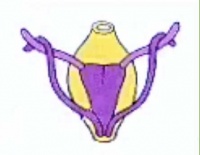
| This animation shows the posterior of the developing bladder between Week 4 and 6. | |||
* The mesonephric duct (purple) has lateral branches forming the uteric bud (kidney) | |||
* both these fuse into the wall of the bladder (yellow). | |||
* The mesonephric duct then moves inferiorly to the level of the pelvic urethra. | |||
|} | |||
{| | |||
|+ '''Human Embryo''' (week 8, stage 22) pelvic level cross-section. | |||
| [[File:Stage 22 image 196.jpg|200px]] | |||
| [[File:Stage 22 image 197.jpg|200px]] | |||
| [[File:Stage 22 image 198.jpg|200px]] | |||
|- | |||
| [[:File:Stage 22 image 196.jpg|G5 urogenital]] | |||
| [[:File:Stage 22 image 197.jpg|G6 urogenital]] | |||
| [[:File:Stage 22 image 198.jpg|G7 urogenital]] | |||
|} | |||
==Additional Information== | |||
{{Genital Links}} | |||
{{Renal Links}} | |||
==References== | |||
<references/> | |||
Latest revision as of 15:21, 21 September 2011
| 2011 Lab 8: Introduction | Sex Determination | Early Embryo | Late Embryo | Fetal | Postnatal | Abnormalities | Quiz | Online Assessment |
Week 8
|
<wikiflv width="560" height="588" autoplay="true" position="left">Stage22_urogenlarge.flv|File:Stage22-UG-icon.jpg</wikiflv> (Carnegie stage 22, male) Quicktime |
Begin by observing the internal structure of the embryo at the end of week 8.
|
Embryo (week 8, Stage 22) Renal

E6: R,L adrenal glands under diaphragm.
E7: Large adrenal glands. Inferior vena cava. Thoracic aorta. |

|

|

|
| F1: Adrenal glands. R. Kidney. Autonomic ganglia (partly the adrenal medulla precursors). | F2: Kidneys (note retroperitoneal location). Cortex. Medulla. L. Adrenal gland. Superior mesenteric artery. Inferior vena cava. | F3: R testis (note its location relative to the R adrenal). L adrenal. R renal hilus. large channels are branches of ureteric tree. | |

|

|

|

|
| F4: R kidney and R ureter. Inferior vena cava. L. kidney, L renal hilus and L ureter. R testis with R mesonephric duct (precursor of vas deferens). L testis. Umbilical arteries passing into umbilical cord allantois between them. | F5: Kidneys. Ureters. Note umbilical arteries and allantois. Also note how R testis and mesonephric structures are attached to parietal peritoneum by a mesogonad. | F6: Kidneys. Ureters. Note umbilical arteries and allantois. Also note how R testis and mesonephric structures are attached to parietal peritoneum by a mesogonad. | F7: In F7, (dorsal to R testis and liver) note with the distinct lumen of the mesonephric duct, almost solid column of paramesonephric cells and remnants of mesonephric tubules. "mesogonad". Ureters. Bladder with submucosa and detrusor muscle. Umbilical arteries. Division of aorta. |

|

|

|

|
| G1: Ureters, Bladder. Umbilical arteries. Testis with remains of mesonephros (dorsal), mesonephric duct and paramesonephric cells. Sigmoid colon and mesocolon. | G2: Ureters being displaced ventrally, crossing common iliac arteries. Sigmoid colon. Bladder. Mesonephric ducts (lateral) and paramesonephric ducts (smaller, medial) located dorsal to bladder. | G3: Ureters (cut twice): descending dorsal to bladder and ascending ventrally to enter the bladder at trigone, through the submucosa). Fusion of paramesonephric ducts. Paired mesonephric ducts. Umbilical arteries looping off common iliac arteries. Pubic symphysis. Colon. | G4: Most caudal part of loop of ureters. Urethra emerging from bladder. Mesonephric ducts. Rectocolic junction. |

|

|

|
|
| G5: Urethra (in region of future prostate gland - note crescentic shape). Rectum. Rectovesical pouch. Between G4 and G5, each mesonephric duct (vas deferens) has joined the prostatic urethra (caudal to the ureters), thereby increasing the caliber of the latter. | G6: Penile urethra, emerging inferiorly to the glans penis. Scrotal swellings (appear before testis descends). | G7: Penile urethra, emerging inferiorly to the glans penis. Scrotal swellings (appear before testis descends). | Note F7 MS term: "inebriated Puffin" (dorsal to R testis and liver) lumen of the mesonephric duct (eye), almost solid column of paramesonephric cells (beak) and remnants of mesonephric tubules (body). |

Urinary System Development
- The adult kidneys (the metanephroi) form from day 35, from a portion of the intermediate mesoderm called the metanephric blastema (or metanephric mesenchyme).
- They are induced to form by the ureteric buds, outgrowths from the end of the mesonephric ducts, which come into contact with the metanephric blastema.
- Upon contact, they begin to lengthen and bifurcate rapidly in the metanephric blastema – these branches differentiate into the collecting ducts.
- Both the ureteric buds and the metanephric blastema begin to differentiate; interestingly each induces differentiation in the other structure.
- The ureteric bud is induced by the metanephric blastema to form the collecting tubules, renal pelvis and ureters.
- The metanephric blastema is induced to form the nephrons.
Development of the Kidney
| File:Renal blood 01 icon.jpg</wikiflv> |
|
Development of the Urinary Bladder
| File:Urogenital_septum_001 icon.jpg</wikiflv> | Division of the Cloaca
|
Development of the Urethra
- Further development of the urinary system varies depending on the sex of the embryo.
- Males - the pelvic urethra forms the membranous urethra, the prostatic urethra and penile urethra. (The sex of the above animation and sections is male)
- Females - the pelvic urethra forms the membranous urethra and the vestibule of the vagina.
Genital System Development

Male Human Embryo (week 8, stage 22) Detail from cross-section showing mesonephros, mesonephric duct, paramesonephric duct and developing testis. |
Until the end of the 6th week the male and female genital systems are indistinguishable. Sex differentiation is based upon the presence of the specific sex chromosomes.
|
Male

|

|
| G3 testis | G4 rete tesits |
- week 8 - males Sertoli cells secrete anti müllerian hormone (AMH), which causes regression of the paramesonephric ducts between the 8th and 10th weeks.
- week 9 to 10 - gonadal cells begin to produce testosterone, which maintains the mesonephric ducts.
- mesonephric ducts go on to form the internal genital tract:
- rete testis
- ductuli efferentes
- vas deferens
Female
- during the same time course as above, the opposite occurs.
- The sex cords degenerate and the genital ridge forms secondary cortical sex cords.
- These induce the primordial germ cells to form the ovarian follicles.
- Due to the lack of AMH and testosterone, the mesonephric ducts degenerate
- paramesonephric ducts go on to form the internal genital tract:
- uterine (fallopian) tubes
- uterus body
- vagina
In both sexes, the external genitalia appear similar until the 12th week.
Trigone
|
This animation shows the posterior of the developing bladder between Week 4 and 6.
|

|

|

|
| G5 urogenital | G6 urogenital | G7 urogenital |
Additional Information
| Renal Links: renal | Lecture - Renal | Lecture Movie | urinary bladder | Stage 13 | Stage 22 | Fetal | Renal Movies | Stage 22 Movie | renal histology | renal abnormalities | Molecular | Category:Renal | ||
|
References
| 2011 Lab 8: Introduction | Sex Determination | Early Embryo | Late Embryo | Fetal | Postnatal | Abnormalities | Quiz | Online Assessment |
Glossary Links
- Glossary: A | B | C | D | E | F | G | H | I | J | K | L | M | N | O | P | Q | R | S | T | U | V | W | X | Y | Z | Numbers | Symbols | Term Link
Cite this page: Hill, M.A. (2026, August 14) Embryology 2011 Lab 8 - Late Embryo. Retrieved from https://embryology.med.unsw.edu.au/embryology/index.php/2011_Lab_8_-_Late_Embryo
- © Dr Mark Hill 2026, UNSW Embryology ISBN: 978 0 7334 2609 4 - UNSW CRICOS Provider Code No. 00098G
