Lymph Node Development: Difference between revisions
| Line 27: | Line 27: | ||
| [[File:Lymph node structure 02.jpg]] | | [[File:Lymph node structure 02.jpg]] | ||
| Schematic representation of the organization of a lymph node.<ref><pubmed>19644499</pubmed>| [http://www.ncbi.nlm.nih.gov/pmc/articles/PMC2785037 PMC2785037] | [http://www.nature.com/nri/journal/v9/n9/abs/nri2588.html Nat Rev Immunol.]</ref> | | Schematic representation of the organization of a lymph node.<ref><pubmed>19644499</pubmed>| [http://www.ncbi.nlm.nih.gov/pmc/articles/PMC2785037 PMC2785037] | [http://www.nature.com/nri/journal/v9/n9/abs/nri2588.html Nat Rev Immunol.]</ref> | ||
* Afferent lymphatics enter lymph nodes and deliver lymph to the subcapsular sinus (SCS), which forms a channel around the periphery of the lymph node. | * '''Afferent lymphatics''' enter lymph nodes and deliver lymph to the '''subcapsular sinus''' (SCS), which forms a channel around the periphery of the lymph node. | ||
* Lymphatic sinuses run from the SCS through the cortex to the medulla, and exit the lymph node via efferent lymphatic vessels on the opposite, hilar, side of the organ. | * '''Lymphatic sinuses''' run from the SCS through the cortex to the medulla, and exit the lymph node via '''efferent lymphatic vessels''' on the opposite, hilar, side of the organ. | ||
* B cell follicles containing follicular dendritic cell (FDC) networks are arranged in the lymph node cortex and are separated from the SCS by a layer of marginal reticular cells (MRC). | * '''B cell follicles''' containing follicular dendritic cell (FDC) networks are arranged in the lymph node cortex and are separated from the SCS by a layer of marginal reticular cells (MRC). | ||
* | * '''T cells zones''' in the paracortex, which contain many fibroblastic reticular cells (FRC), are separated by the cortical ridge, an area rich in T cells, dendritic cells (DCs), blood vessels, and FRC. | ||
* Blood vessels enter and exit the lymph node on the hilar side, and snake through the lymph node like the branches of a tree. | * Blood vessels enter and exit the lymph node on the hilar side, and snake through the lymph node like the branches of a tree. | ||
* Specialized high endothelial venules (HEVs) in the paracortex and cortical ridge allow entry of leukocytes from the blood. | * Specialized high endothelial venules (HEVs) in the paracortex and cortical ridge allow entry of leukocytes from the blood. | ||
Revision as of 01:57, 24 February 2012
Introduction


Lymphatic vasculature drains lymph fluid from the organ tissue space and returns it to the blood vasculature for recirculation. Lymph nodes lie on the path of lymph vessels and these structures monitor and carry out immune surveillance of this fluid for antigens and pathogens, trapping them within the lymph nodes and generating immune responses.
Some Recent Findings
|
Adult Lymph Node
- Encapsulated organ (1 mm - 2 cm)
- In lymph vessel pathways “filter”
- Afferent- towards node
- Efferent- away from node
- Location throughout the entire body - Concentrated in axilla, groin, mesenteries
- Antigen transformed lymphocytes from the blood
- Links: Immunobiology - Figure 1.8. Organization of a lymph node | MBoC Figure 24-16. A simplified drawing of a human lymph node

|
Schematic representation of the organization of a lymph node.[2]
|

Adult Lymph Node Structure
- Capsule - dense connective tissue
- Trabeculae - dense connective tissue
- Reticular Tissue - Reticular cells and fibers, supporting meshwork
- Macrophages - process antigen, difficult to distinguish from the reticular cells.


Lymph
- enters the node through afferent vessels
- filters through the sinuses
- leaves through efferent vessels
Subcapsular sinus = marginal sinus

Continuation of trabecular sinus

Adult Lymphocytes
The following data is from a recent article[3] and review[4] of live adult mouse lymphocytes (T and B cells) imaged within a lymph node.
Both lymphocyte types:
- Spend 8 to 24 h in the lymph node interstitium.
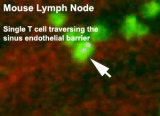
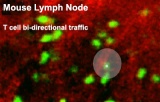
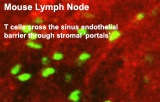
- Transit across a lymphatic endothelium to exit.
- Enter a network of medullary sinuses.
- Drain from sinuses into efferent lymphatic vessels.
Lymphocyte Migration Speeds
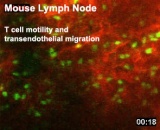
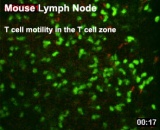
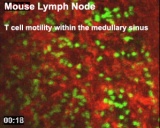
T cells - 10–12 μm/min in the follicle diffuse cortex, peak velocities up to 30 μm/min. (move more slowly in the medullary region near the hilus of the lymph node than in the paracortex)
B cells - 6 μm/min in the follicle diffuse cortex, peak velocities up to 20 μm/min.
Both cortical T cells and follicular B cells move in random directions following "guide cells".
Lymphocyte Guide Cells
FDC - Follicular Dendritic Cells, may guide B cells in the follicle.
FRC - Fibroblastic Reticular Cells, may guide T cells in the follicle.
Lymphocyte Movies
Adult Mouse Lymph Node - T cell motility
|
|
|
| Transendothelial migration | T cell zone | Medullary sinus |
|
|
|
| Sinus endothelial barrier | Bi-directional traffic | Cross the sinus endothelial barrier |
References
- ↑ <pubmed>19060331</pubmed>
- ↑ <pubmed>19644499</pubmed>| PMC2785037 | Nat Rev Immunol.
- ↑ <pubmed>16273098</pubmed>
- ↑ <pubmed>18173372</pubmed>
Reviews
<pubmed></pubmed>
Articles
<pubmed>165702</pubmed> <pubmed>1167215</pubmed>
Glossary Links
- Glossary: A | B | C | D | E | F | G | H | I | J | K | L | M | N | O | P | Q | R | S | T | U | V | W | X | Y | Z | Numbers | Symbols | Term Link
Cite this page: Hill, M.A. (2026, August 15) Embryology Lymph Node Development. Retrieved from https://embryology.med.unsw.edu.au/embryology/index.php/Lymph_Node_Development
- © Dr Mark Hill 2026, UNSW Embryology ISBN: 978 0 7334 2609 4 - UNSW CRICOS Provider Code No. 00098G
