File:Placenta potential imprinted genes.png: Difference between revisions
No edit summary |
mNo edit summary |
||
| Line 3: | Line 3: | ||
Villous trophoblasts of the human placenta grow as a branched structure, maximising exchange with maternal blood. Extravillous trophoblast invade into the maternal endometrium, and some cells colonise maternal spiral arteries, expanding them to maximise blood flow. ♂ = Paternally expressed; ♀ = maternally expressed. Imprinted genes are important during fetal growth. Some, such as GNAS, UBE3A, and PLAGL, have physiological impact on the fetus only. Other genes may influence growth in utero via the placenta, or the fetus and placenta. The IUGR seen in SRS, and overgrowth in BWS are suggestive of a role of IGF2 in the human placenta. | Villous trophoblasts of the human placenta grow as a branched structure, maximising exchange with maternal blood. Extravillous trophoblast invade into the maternal endometrium, and some cells colonise maternal spiral arteries, expanding them to maximise blood flow. ♂ = Paternally expressed; ♀ = maternally expressed. Imprinted genes are important during fetal growth. Some, such as GNAS, UBE3A, and PLAGL, have physiological impact on the fetus only. Other genes may influence growth in utero via the placenta, or the fetus and placenta. The IUGR seen in SRS, and overgrowth in BWS are suggestive of a role of IGF2 in the human placenta. | ||
===Reference=== | |||
Citation: Frost JM, Moore GE (2010) The Importance of Imprinting in the Human Placenta. PLoS Genet 6(7): e1001015. doi:10.1371/journal.pgen.1001015 | Citation: Frost JM, Moore GE (2010) The Importance of Imprinting in the Human Placenta. PLoS Genet 6(7): e1001015. doi:10.1371/journal.pgen.1001015 | ||
| Line 14: | Line 11: | ||
Published: July 1, 2010 | Published: July 1, 2010 | ||
Copyright | ====Copyright==== | ||
© 2010 Frost, Moore. This is an open-access article distributed under the terms of the Creative Commons Attribution License, which permits unrestricted use, distribution, and reproduction in any medium, provided the original author and source are credited. | |||
Journal.pgen.1001015.g001.png | |||
http://www.plosgenetics.org/article/info%3Adoi%2F10.1371%2Fjournal.pgen.1001015 | |||
[[Category:Placenta]] [[Category:Molecular]] [[Category:Epigenetics]] [[Category:Imprinting]] | [[Category:Placenta]] [[Category:Molecular]] [[Category:Epigenetics]] [[Category:Imprinting]] | ||
Revision as of 11:45, 1 Haziran 2013
The human fetus and placenta
Villous trophoblasts of the human placenta grow as a branched structure, maximising exchange with maternal blood. Extravillous trophoblast invade into the maternal endometrium, and some cells colonise maternal spiral arteries, expanding them to maximise blood flow. ♂ = Paternally expressed; ♀ = maternally expressed. Imprinted genes are important during fetal growth. Some, such as GNAS, UBE3A, and PLAGL, have physiological impact on the fetus only. Other genes may influence growth in utero via the placenta, or the fetus and placenta. The IUGR seen in SRS, and overgrowth in BWS are suggestive of a role of IGF2 in the human placenta.
Reference
Citation: Frost JM, Moore GE (2010) The Importance of Imprinting in the Human Placenta. PLoS Genet 6(7): e1001015. doi:10.1371/journal.pgen.1001015
Editor: Anne C. Ferguson-Smith, University of Cambridge, United Kingdom
Published: July 1, 2010
Copyright
© 2010 Frost, Moore. This is an open-access article distributed under the terms of the Creative Commons Attribution License, which permits unrestricted use, distribution, and reproduction in any medium, provided the original author and source are credited.
Journal.pgen.1001015.g001.png
http://www.plosgenetics.org/article/info%3Adoi%2F10.1371%2Fjournal.pgen.1001015
File history
Yi efo/eka'e gwa ebo wo le nyangagi wuncin ye kamina wunga tinya nan
| Gwalagizhi | Nyangagi | Dimensions | User | Comment | |
|---|---|---|---|---|---|
| current | 08:45, 6 August 2010 | 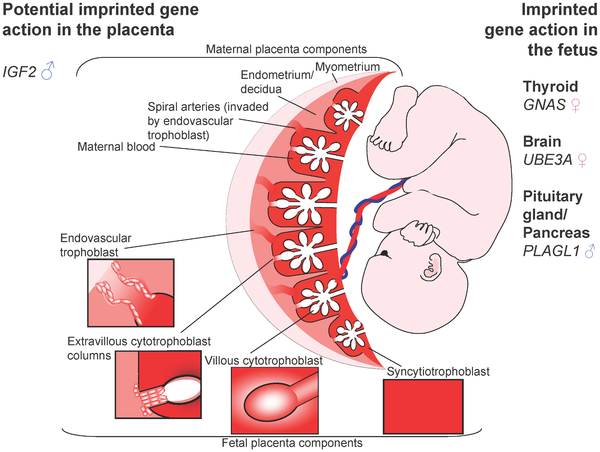 | 600 × 452 (416 KB) | S8600021 (talk | contribs) | Figure 1. The human fetus and placenta. Villous trophoblasts of the human placenta grow as a branched structure, maximising exchange with maternal blood. Extravillous trophoblast invade into the maternal endometrium, and some cells colonise maternal spir |
You cannot overwrite this file.
File usage
The following 2 pages use this file:


