File:Limb induction-initiation signal 02.jpg
Original file (1,280 × 1,009 pixels, file size: 124 KB, MIME type: image/jpeg)
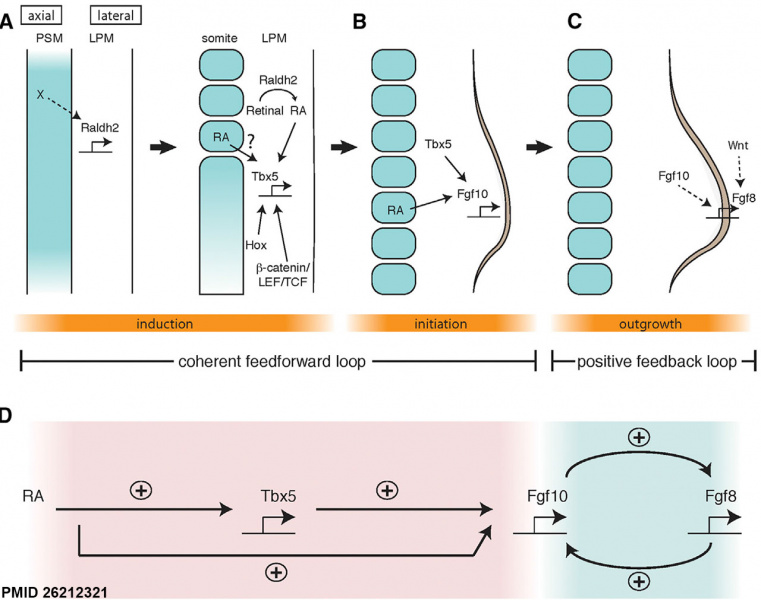
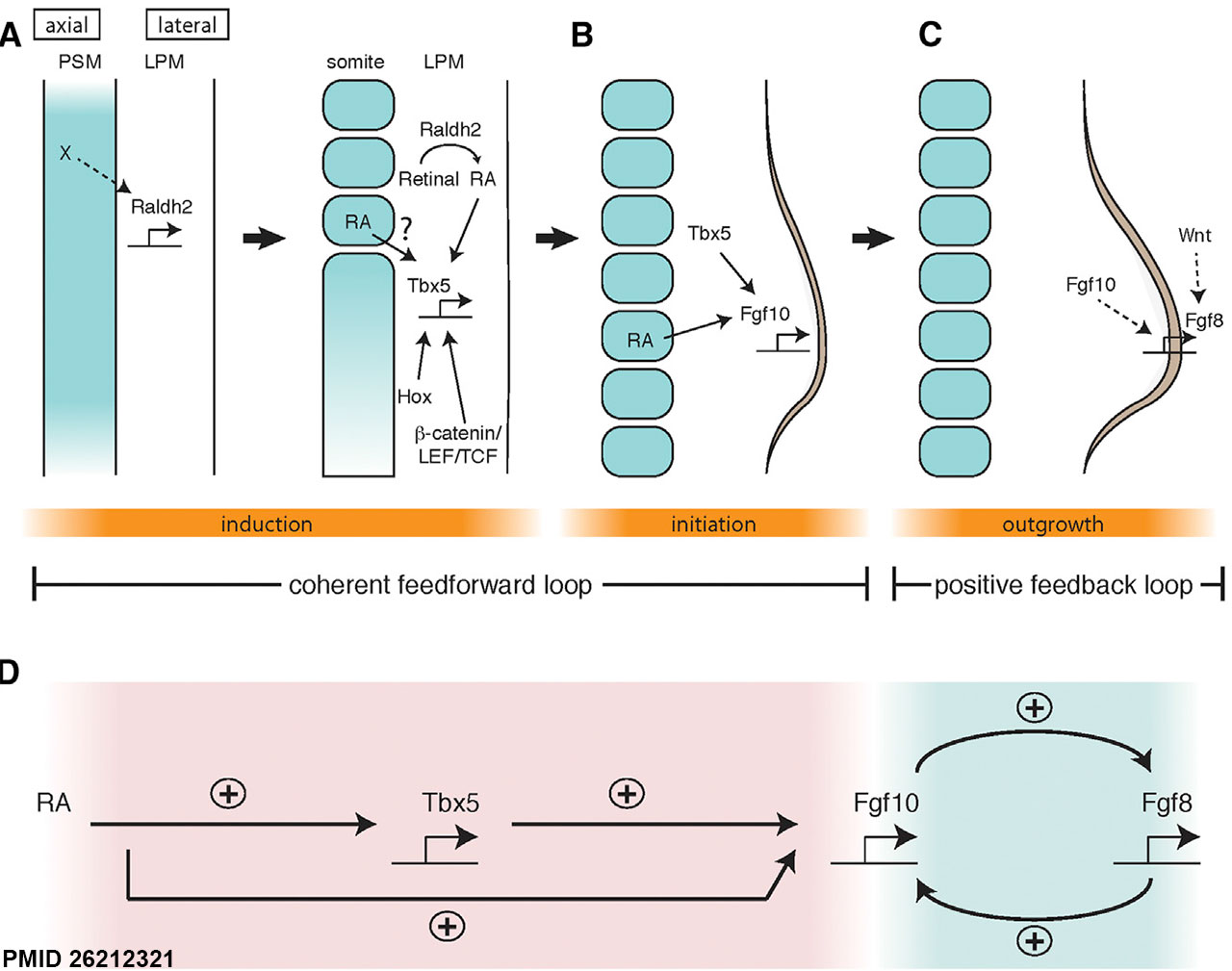
Figure 7. The Molecular Mechanisms of Limb Bud Formation (A) During limb induction, an axial signal is required for Raldh2 expression in the LPM, which produces RA locally. RA, b-catenin/TCF/LEF, and Hox genes act cooperatively to induce Tbx5 in the LPM. (B) Subsequently, RA from the somite functions cooperatively with Tbx5 to induce Fgf10 expres- sion. Thus, RA and Tbx transcription factors act in a coherent feed-forward loop (D). (C and D) Fgf10 in limb bud mesenchyme induces Fgf8 expression (C) in the overlying ectoderm to establish an Fgf10-Fgf8 positive feedback loop required for outgrowth (D).
File history
Yi efo/eka'e gwa ebo wo le nyangagi wuncin ye kamina wunga tinya nan
| Gwalagizhi | Nyangagi | Dimensions | User | Comment | |
|---|---|---|---|---|---|
| current | 14:13, 13 September 2016 | | 1,280 × 1,009 (124 KB) | Z8600021 (talk | contribs) | Figure 7. The Molecular Mechanisms of Limb Bud Formation (A) During limb induction, an axial signal is required for Raldh2 expression in the LPM, which produces RA locally. RA, b-catenin/TCF/LEF, and Hox genes act cooperatively to induce Tbx5 in the LP... |
You cannot overwrite this file.
File usage
The following page uses this file: