Talk:Draft 2016: Difference between revisions
From Embryology
| Line 50: | Line 50: | ||
# Drain from sinuses into efferent lymphatic vessels. | # Drain from sinuses into efferent lymphatic vessels. | ||
|- | |- | ||
| Lymph pathway | |||
# Afferent vessel | |||
# Subcapsular sinus | |||
# Paratrabecular sinus | |||
# Medullary sinus | |||
# Efferent vessel | |||
| {{Lymph Node Movie 7}}{{Lymph Node Movie 8}} | | {{Lymph Node Movie 7}}{{Lymph Node Movie 8}} | ||
Revision as of 18:32, 26 February 2016
Lymph Nodes
Lymph Node Anatomy
| Lymph Node Anatomy | |
|---|---|
Mesenteric lymph nodes |

|

Lymph Node Functions
| Lymph Node Functions | |
|---|---|
|

|
Lymph Node Structure
| Lymph Node Structure | |||||||
|---|---|---|---|---|---|---|---|

Simplified structure |

Lymphocyte (T and B) Traffic
| ||||||
Lymph pathway
|
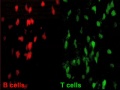
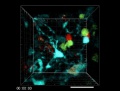
T and B motility | ||||||
Lymph Node Histology
| Lymph Node Histology | ||||||
|---|---|---|---|---|---|---|
|


Lymph Nodes
Lymph Node Structure

Connective Tissue
- Capsule - dense connective tissue (irregular CT, some adipocytes))
- Trabeculae - dense connective tissue
- Reticular Tissue - Reticular cells and fibers, supporting meshwork (collagen type III)
- Reticular cell produces reticular fibers (collagen type III) and surrounds the fibers with its cytoplasm
- reticular fibbers can also be produced by fibroblasts
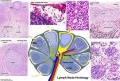
Cartoon with histology features
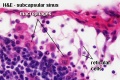
Subcapsular Sinus (marginal sinus, continuation of trabecular sinus)
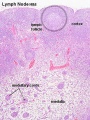
Follicle
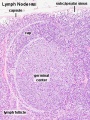
Germinal Centre
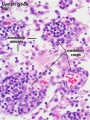
Medullary Cords and Sinuses
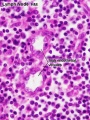
High Endothelial Venules
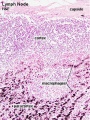
Macrophages


Lymphocyte (T and B) Traffic
Important - Please note that the lymphocytes exit from the node by efferent lymphatic vessels. See also Image - Cell Trafficking into and out of Lymph Nodes. |
T and B motility |
T and B interaction |

High Endothelial Venules See also Lymphocyte Migration at High Endothelial Venule Model |
Links: Immunobiology - Figure 1.8. Organization of a lymph node


