File:Steroid biosynthesis pathway.png: Difference between revisions
No edit summary |
mNo edit summary |
||
| Line 1: | Line 1: | ||
==Steroid Biosynthesis Pathway== | |||
A simplified version of steroid biosynthesis highlighting the specific steroidogenic enzymes | A simplified version of steroid biosynthesis highlighting the specific steroidogenic enzymes. Filled boxes highlight the steroidogenic enzymes examined by RT-qPCR in the original article. | ||
Progesterone (P4) is highlighted as the focus of this study. First, the transport protein, steroidogenic acute regulatory protein (StAR) is needed to facilitate the movement of cholesterol from the outer to inner mitochondrial membrane. Cholesterol is then converted to pregnenolone by the action of cytochrome side-chain cleaving enzyme (P450scc). Pregnenolone can then be converted to either 17α-hydroxypregnenolone by 17α-hydroxylase (P45017α) or to P4 by 3β-hydroxysteroid dehydrogenase (3β-HSD). P4 can either be a final product in this pathway or serve as a precursor in the synthesis of glucocorticoids, androgens, or estrogens. 17β-hydroxysteroid dehydrogenase (17β-HSD) functions in the conversion of weaker and stronger androgens and estrogens and was included in this study as a marker of upstream steroid enzyme activity. | |||
http://www.plosone.org/article/info%3Adoi%2F10.1371%2Fjournal.pone.0005452 | ===Reference=== | ||
<pubmed>19424488</pubmed>| [http://www.ncbi.nlm.nih.gov/pmc/articles/PMC2674930 PMC2674930 ] | [http://www.plosone.org/article/info%3Adoi%2F10.1371%2Fjournal.pone.0005452 PLoS One.] | |||
====Copyright==== | |||
© 2009 Albergotti et al. This is an open-access article distributed under the terms of the Creative Commons Attribution License, which permits unrestricted use, distribution, and reproduction in any medium, provided the original author and source are credited. | |||
Citation: Albergotti LC, Hamlin HJ, McCoy MW, Guillette, LJ Jr (2009) Endocrine Activity of Extraembryonic Membranes Extends beyond Placental Amniotes. PLoS ONE 4(5): e5452. doi:10.1371/journal.pone.0005452 | Citation: Albergotti LC, Hamlin HJ, McCoy MW, Guillette, LJ Jr (2009) Endocrine Activity of Extraembryonic Membranes Extends beyond Placental Amniotes. PLoS ONE 4(5): e5452. doi:10.1371/journal.pone.0005452 | ||
Journal.pone.0005452.g001.png http://www.plosone.org/article/info%3Adoi%2F10.1371%2Fjournal.pone.0005452 | |||
[[Category:Endocrine]] | [[Category:Endocrine]] | ||
Revision as of 15:29, 20 April 2013
Steroid Biosynthesis Pathway
A simplified version of steroid biosynthesis highlighting the specific steroidogenic enzymes. Filled boxes highlight the steroidogenic enzymes examined by RT-qPCR in the original article.
Progesterone (P4) is highlighted as the focus of this study. First, the transport protein, steroidogenic acute regulatory protein (StAR) is needed to facilitate the movement of cholesterol from the outer to inner mitochondrial membrane. Cholesterol is then converted to pregnenolone by the action of cytochrome side-chain cleaving enzyme (P450scc). Pregnenolone can then be converted to either 17α-hydroxypregnenolone by 17α-hydroxylase (P45017α) or to P4 by 3β-hydroxysteroid dehydrogenase (3β-HSD). P4 can either be a final product in this pathway or serve as a precursor in the synthesis of glucocorticoids, androgens, or estrogens. 17β-hydroxysteroid dehydrogenase (17β-HSD) functions in the conversion of weaker and stronger androgens and estrogens and was included in this study as a marker of upstream steroid enzyme activity.
Reference
<pubmed>19424488</pubmed>| PMC2674930 | PLoS One.
Copyright
© 2009 Albergotti et al. This is an open-access article distributed under the terms of the Creative Commons Attribution License, which permits unrestricted use, distribution, and reproduction in any medium, provided the original author and source are credited.
Citation: Albergotti LC, Hamlin HJ, McCoy MW, Guillette, LJ Jr (2009) Endocrine Activity of Extraembryonic Membranes Extends beyond Placental Amniotes. PLoS ONE 4(5): e5452. doi:10.1371/journal.pone.0005452
Journal.pone.0005452.g001.png http://www.plosone.org/article/info%3Adoi%2F10.1371%2Fjournal.pone.0005452
File history
Yi efo/eka'e gwa ebo wo le nyangagi wuncin ye kamina wunga tinya nan
| Gwalagizhi | Nyangagi | Dimensions | User | Comment | |
|---|---|---|---|---|---|
| current | 20:35, 5 October 2009 | 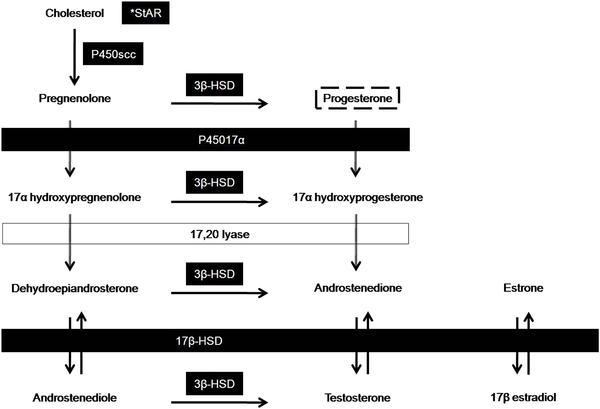 | 600 × 409 (101 KB) | S8600021 (talk | contribs) | Figure 1. Steroid biosynthesis pathway. A simplified version of steroid biosynthesis highlighting the specific steroidogenic enzymes investigated in this study. Filled boxes highlight the steroidogenic enzymes examined by RT-qPCR. Progesterone (P4) is hi |
You cannot overwrite this file.
File usage
The following 5 pages use this file:


