ANAT2341 Lab 7: Difference between revisions

From Embryology
mNo edit summary
No edit summary
 
(63 intermediate revisions by 2 users not shown)
Line 1: Line 1:
=Endocrine and Integumentary=
==Organogenesis Lab==


{{Endocrine Links}}
Please note the different location for this week’s practical class: Wallace Wurth Teaching Lab 116.


{{Integumentary Links}}


'''PRACTICAL CLASS PROGRAM'''


==Introduction==
* Weekly Quiz + revision (15 minutes)
* Practical class activities (90 minutes)
* Practical Class Revision (15 minutes)


# The first half of this laboratory will be a presentation by Dr Annemeik Beverdam.
# The second part of the practical will briefly cover Endocrine and Integumentary Development.


'''PRACTICAL CLASS ACTIVITIES (90 minutes)'''


==Developmental and Regenerative Dermatology Unit==
* Fertile egg dissections, stage definition, and annotations of structures (first 60 minutes)
The presentation will discuss current research in Dr Annemeik Beverdam's laboratory on Skin development and stem cells. There will also be preparation for an assessment item to be prepared for the Stem Cells Practical later in the course.
* Observation of skeletal preparations of chicken and mouse foetuses (first 60 minutes)
* Group presentation of annotated embryo images (final 30 minutes)


'''LEARNING OBJECTIVES'''


:'''Links:''' [http://medicalsciences.med.unsw.edu.au/people/dr-annemiek-beverdam Dr Annemeik Beverdam] | [https://research.unsw.edu.au/projects/dr-annemiek-beverdam Research Projects] | [http://www.ncbi.nlm.nih.gov/pubmed?term=Beverdam%20A%5BAuthor%5D&cauthor=true&cauthor_uid=24040182 Publications]
* Understanding early neurulation, mesoderm and heart development, and being able to identify the defining structures in the chicken embryo.
* Understanding craniofacial and limb development and being able to identify the defining structures in chicken embryos.
* Understanding the development of the musculoskeletal system and being able to identify the defining structures in chicken embryos.
* Be able to apply basic practical laboratory skills and work with embryo and regeneration models.
* Be able to work effectively within a small team to complete academic tasks.
* Be able to present embryonic observations effectively and appropriately to an audience
* Be able to self-manage and work independently with an ability to take responsibility for their own learning, and an appreciation of the value of learning.
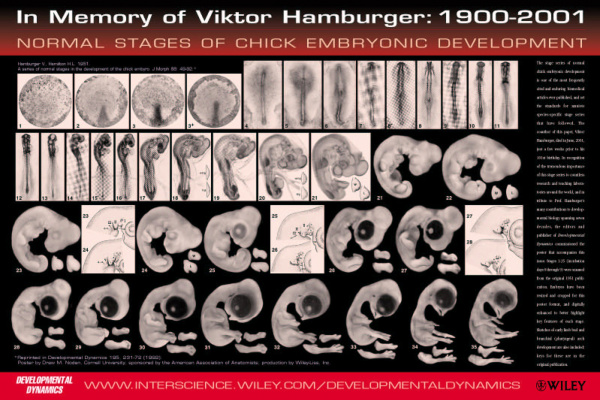


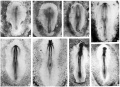
[[File:Chicken_Embryo_Hamburger_stages.jpg|600px|link=Hamburger Hamilton Stages]]


''These are the Hamburger stages of chicken development''


==Endocrine==
[[File:Stage 22 image 221.jpg|thumb|Developing Pituitary - Human Embryo Carnegie stage 22]]
* Begin by working through [[Endocrine_System_-_Carnegie_Stage_22|Endocrine Development by week 8]].
* Then look at the information on each endocrine organ on their related specific page.


{{Endocrine Links}}
See also the [https://www.jove.com/video/306/windowing-chicken-eggs-for-developmental-studies JoVE article on chicken egg preparation]: <pubmed>18989413</pubmed>


==Integumentary==


{{Integumentary Links}}
===Additional Chicken Links===
[[File:Viktor Hamburger.jpg|thumb|alt=Viktor Hamburger|link=Embryology History - Viktor Hamburger|Viktor Hamburger (1900 – 2001)]]
More about chicken embryogenesis: [[Chicken Development]] | [[Hamburger Hamilton Stages]]
<br>
{{Chicken links}}
<br>


===Teeth===
<gallery>
[[File:Fetal_head_lateral.jpg|thumb|Fetal Head (12 weeks) lateral]]
File:HHstage1-4.jpg|stage 1-4
[[File:Deciduous teeth.jpg|thumb|Deciduous teeth]]
File:HHstage5-10.jpg|stages 5-10
[[File:Permanent teeth.jpg|thumb|Permanent teeth]]
File:HHstage11-14.jpg|stages 11-14
* integumentary system specialization by '''epitheilal/mesenchymal''' interactions in development and develops with a major contribution from the neural crest.  
File:HHstage15-18.jpg|stages 15-18
** ectoderm of the first pharyngeal arch and neural crest, ectomesenchymal cells.
File:HHstage19-21.jpg|stages 19-21
File:HHstage22-25.jpg|stages 22-25
File:HHstage26-28.jpg|stages 26-28
File:HHstage29-32.jpg|stage 29-32
</gallery>


[[File:Mouse_vs_Human_embryogenesis.jpg]]


* week 6 - odontogenesis begins, tooth bud
''This figure compares the human and mouse developmental stages''
* 4 morphological stages describing the early tooth development: bud, cap, bell, and terminal differentiation
* 2 sets of teeth: 20 deciduous teeth, 32 permanent teeth
* differential rates of growth, shed at different times over 20 year period
* inductive influence of neural crest with overlying ectoderm
* tooth growth occurs in ossifying jaws 


'''odontoblasts''' - neural crest-derived mesenchymal cells which differentiate under the influence of the enamel epithelium. Cells secrete predentin, calcifies to form dentin.
More about Mouse embryogenesis: [[Mouse Timeline Detailed]]


'''ameloblasts''' - inner enamel epithelium forms pre-ameloblasts differentiate and produce enamel


'''periodontal ligament''' - tooth is not anchored directly onto its bony socket (alveolar bone) but held in place by the periodontal ligament (PDL), a specialized connective tissue structure that surrounds the tooth root coating of cementum.
{{Chicken}}
* ligament also act as; a shock absorber, transmitter of chewing forces (from tooth to bone), sensory information (heat, cold, pressure and pain).
** collagen fiber bundles within the ligament are called "Sharpey's fibres".


'''Tooth Stages'''
===External Links===
{{External Links}}


Tooth development stages<ref name="PMID19266065"><pubmed>19266065</pubmed>| [http://www.pubmedcentral.nih.gov/articlerender.fcgi?artid=2651620&tool=pmcentrez PMCID: PMC2651620]</ref>
* JOVE - [http://www.jove.com/science-education/5153/an-introduction-to-the-chick-gallus-gallus-domesticus An Introduction to the Chicken]
 
{|
|-bgcolor="CEDFF2"
| width= 100px |'''Stage'''
| width= 210px |<center>'''Image'''</center>
| width= 100px |'''Human''' (weeks)
|-
| lamina
| [[File:Tooth stage lamina.jpg|200px|lamina]]
| [[Week 6]]
|-bgcolor="F5FAFF"
| placode
| [[File:Tooth placode stage.jpg|200px|placode stage]]
| [[Week 7]]
|-
| bud
| [[File:Tooth bud stage.jpg|200px|bud stage]]
| [[Week 8]]
|-bgcolor="F5FAFF"
|cap
| [[File:Tooth cap stage.jpg|200px|cap stage]]
| Week 11
|-
| bell
| [[File:Tooth bell stage.jpg|200px|bell stage]]
| Week 14
|-bgcolor="F5FAFF"
|
|
|
|}
 
=== Teeth Postnatal ===
Deciduous teeth
* '''6 - 24 months''' - erupt from gums by pushing toward surface
* '''2 years''' - all deciduous teeth present
 
Permanent teeth
* 6 years until early adult
* tooth bud lie in gums beneath deciduous teeth
* osteoclasts resorb deciduous teeth roots
* growth affects face shape
 
:'''Links:''' [[Integumentary_System_-_Tooth_Development|Tooth Development]]
 
==Individual Assessment==
 
# Identify and write a brief description of the findings of a recent research paper on development of one of the endocrine organs covered in today's practical.
# Identify the embryonic layers and tissues that contribute to the developing teeth.
 
==Group Project==
* Peer Assessment of your project should now appear on your group discussion page.
* Now you can make changes to your project based upon these reviews and your own concepts of how the project can be improved.
* At this time it is important that you interact with other group members to ensure they agree on the changes you may make.
* You may add additional content to your project.
* Look through the comments made by your peers and assemble a summary of good (positive) and bad (negative) feedback on your project.
** What are the common features of peer comments?
* Fix those minor problems (formatting, image size, image labelling, text, referencing)
* Are there parts of your project where group members have not worked appropriately or contributed their work?
** I will initially be discussing this with the groups individually. You will also have the opportunity to "feed back" contribution issues.
 
===Plagiarism===
Currently all students originally assigned to each group are listed as equal authors/contributors to their project. If you have not contributed the content you had originally agreed to, nor participated in the group work process, then you should contact the course coordinator immediately and either discuss your contribution or request removal from the group author list. Remember that all student online contributions are recorded by date, time and the actual contributed content. A similar email reminder will be sent to all current students.
 
Please note the [https://my.unsw.edu.au/student/atoz/Plagiarism.html Universities Policy regarding Plagiarism]
 
In particular this example:
 
:"Claiming credit for a proportion of work contributed to a group assessment item that is greater than that actually contributed;"
 
Academic Misconduct carries penalties. If a student is found guilty of academic misconduct, the penalties include warnings, remedial educative action, being failed in an assignment or excluded from the University for two years.
 
----
 
==SOMS Summer Research Awards==
 
* The Research Support Committee is pleased to announce that it will again be offering Summer Research Awards (SRAs).
* These awards are for undergraduate students carrying out supervised research in SOMS between November 2012 and February 2013.
* Successful students will receive a stipend each week for 6 weeks of research. [http://medicalsciences.med.unsw.edu.au/students/undergraduate/summer-research-awards More Information?]
 
==References==
 
<references/>


{{2014ANAT2341}}

Latest revision as of 11:38, 22 October 2019

Organogenesis Lab

Please note the different location for this week’s practical class: Wallace Wurth Teaching Lab 116.


PRACTICAL CLASS PROGRAM

  • Weekly Quiz + revision (15 minutes)
  • Practical class activities (90 minutes)
  • Practical Class Revision (15 minutes)


PRACTICAL CLASS ACTIVITIES (90 minutes)

  • Fertile egg dissections, stage definition, and annotations of structures (first 60 minutes)
  • Observation of skeletal preparations of chicken and mouse foetuses (first 60 minutes)
  • Group presentation of annotated embryo images (final 30 minutes)


LEARNING OBJECTIVES

  • Understanding early neurulation, mesoderm and heart development, and being able to identify the defining structures in the chicken embryo.
  • Understanding craniofacial and limb development and being able to identify the defining structures in chicken embryos.
  • Understanding the development of the musculoskeletal system and being able to identify the defining structures in chicken embryos.
  • Be able to apply basic practical laboratory skills and work with embryo and regeneration models.
  • Be able to work effectively within a small team to complete academic tasks.
  • Be able to present embryonic observations effectively and appropriately to an audience
  • Be able to self-manage and work independently with an ability to take responsibility for their own learning, and an appreciation of the value of learning.


Chicken Embryo Hamburger stages.jpg

These are the Hamburger stages of chicken development


See also the JoVE article on chicken egg preparation: <pubmed>18989413</pubmed>


Additional Chicken Links
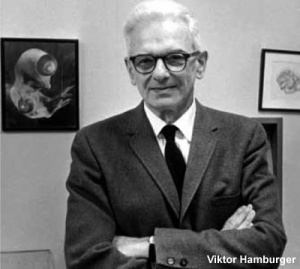
Viktor Hamburger
Viktor Hamburger (1900 – 2001)

More about chicken embryogenesis: Chicken Development | Hamburger Hamilton Stages
Chicken Links: Introduction | Chicken stages | Hamburger Hamilton Stages | Witschi Stages | Placodes | Category:Chicken
Historic Chicken Embryology  
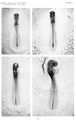
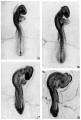
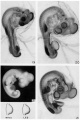
1883 History of the Chick | 1900 Chicken Embryo Development Plates | 1904 X-Ray Effects | 1910 Somites | 1914 Primordial Germ Cells

1919 Lillie Textbook | 1920 Chick Early Embryology | 1933 Neural | 1939 Sternum | 1948 Limb | Movie 1961 | Historic Papers


Mouse vs Human embryogenesis.jpg

This figure compares the human and mouse developmental stages

More about Mouse embryogenesis: Mouse Timeline Detailed


chicken

External Links

External Links Notice - The dynamic nature of the internet may mean that some of these listed links may no longer function. If the link no longer works search the web with the link text or name. Links to any external commercial sites are provided for information purposes only and should never be considered an endorsement. UNSW Embryology is provided as an educational resource with no clinical information or commercial affiliation.