File:Epidermal growth factor receptor signaling pathways.jpg
Original file (1,280 × 938 pixels, file size: 296 KB, MIME type: image/jpeg)
Epidermal Growth Factor Receptor (EGFR) Signaling
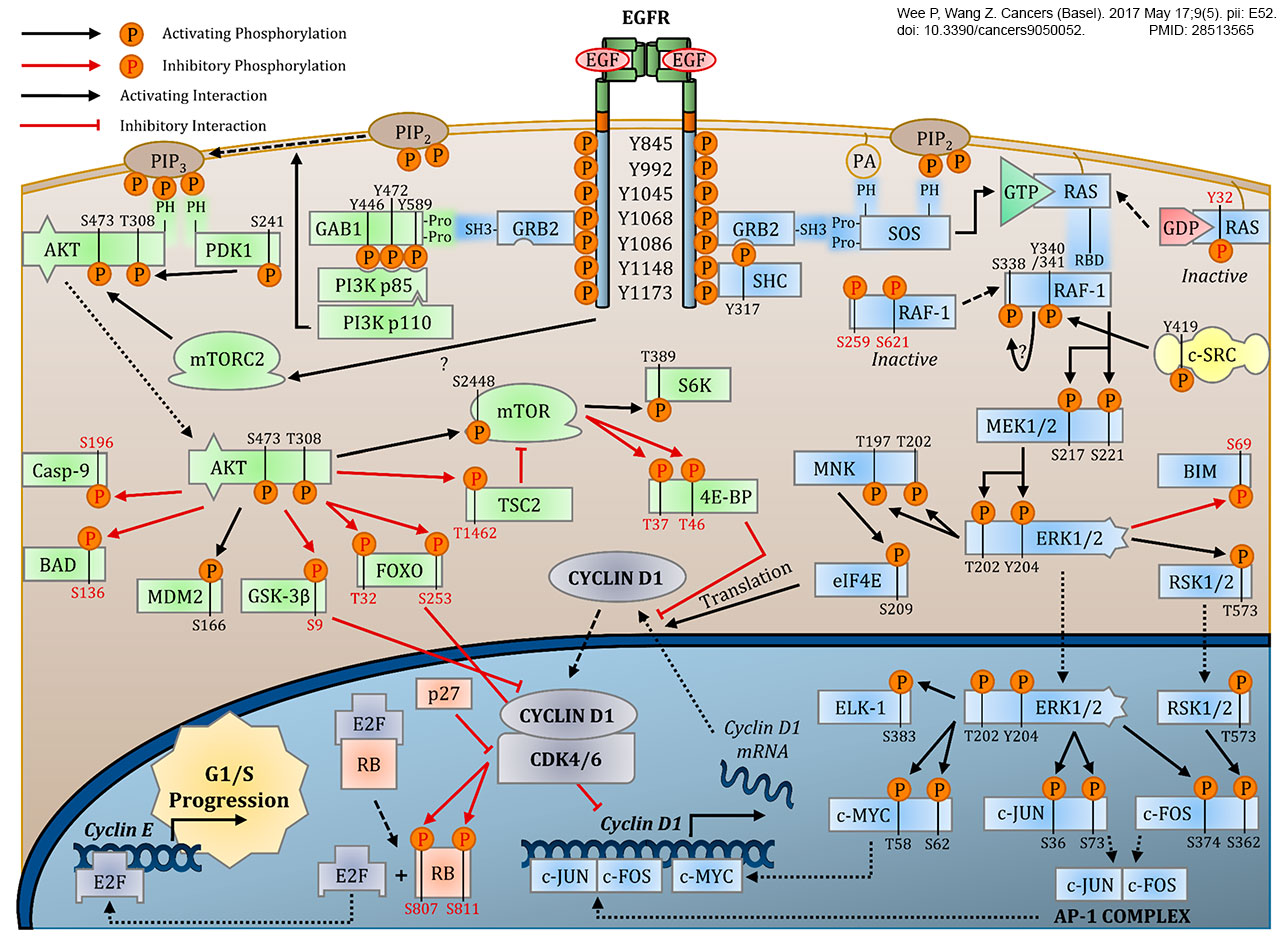
Pathways leading to G1/S cell cycle progression activated by EGF activation. Depicted are the RAS-RAF-MEK-ERK MAPK and PI3K-AKT-mTOR pathways.
EGF activation of the EGFR induces receptor dimerization and transphosphorylation of the C-terminal domain.
The phosphorylated C-terminal domain binds SHC and GRB2, along with PLC-γ1 at Y992 (not pictured).
The GRB2 SH3 domain recruits the proline-rich domains of SOS or GAB1 to initiate ERK MAPK or AKT signaling respectively. SOS is also recruited to the plasma membrane (PM) by the interaction of its PH (pleckstrin homology) domains with PIP2 (phosphatidylinositol-4,5-bisphosphate) and PA (phosphatidic acid). SOS catalyzes the conversion of GDP to GTP of RAS. Active RAS uses its RAS RAF-binding domain (RBD) to recruit RAF-1. RAF-1 is activated by dephosphorylation and phosphorylation events, and activates MEK1/2. Activated MEK1/2 activates ERK1/2. ERK1/2 has various cytoplasmic and nuclear targets, which aid in the transcription and translation of Cyclin D1. For example, ELK-1 transcribes the c-FOS gene (not pictured), and the protein product together with c-JUN make up the AP-1 complex. The AP-1 complex as well as c-MYC induce the transcription of CYCLIN D1.
On the other hand, the receptor-bound GRB2 also binds GAB1. GAB1 recruits the p85 regulatory subunit of PI3K, which binds the p110 catalytic subunit. PI3K converts PIP2 into PIP3 (phosphatidylinositol-3,4,5-triphosphate). PIP3 recruits AKT, and is phosphorylated and activated by PDK1 and mTORC2. AKT has many phosphorylation substrates, including various inhibitory phosphorylations to proteins that negatively regulate CYCLIN D1 activity such as GSK-3β (normally induces CYCLIN D1 degradation) and FOXO (normally represses CYCLIN D1 transcription). Furthermore, AKT inhibition of TSC2 allows the activation of mTOR, which inhibits the inhibitor of translation 4E-BP, thus allowing eIF4E-mediated translation of CYCLIN D1. Increased levels of CYCLIN D1 correlates with increased CDK4/6 activity, which phosphorylates RB. Phosphorylated RB releases the E2F transcription factor, which participates in the transcription of Cyclin E and leads to G1/S progression.
The CDK inhibitor protein p27 inhibits CYCLIN D-CDK4/6 activity.
However, activated ERK, c-MYC, AKT, all inhibit p27 activity. Importantly, the activated ERK MAPK and AKT pathways also inhibit various pro-apoptotic proteins, including BIM, Caspase-9, and BAD.
Reference
<pubmed>28513565 </pubmed>
Wee, P.; Wang, Z. Epidermal Growth Factor Receptor Cell Proliferation Signaling Pathways. Cancers 2017, 9, 52.
Copyright
https://creativecommons.org/licenses/by/4.0/
Fig 1. Cancers-09-00052-g001.png adjusted in size and citation added to image.
Cite this page: Hill, M.A. (2026, September 30) Embryology Epidermal growth factor receptor signaling pathways.jpg. Retrieved from https://embryology.med.unsw.edu.au/embryology/index.php/File:Epidermal_growth_factor_receptor_signaling_pathways.jpg
- © Dr Mark Hill 2026, UNSW Embryology ISBN: 978 0 7334 2609 4 - UNSW CRICOS Provider Code No. 00098G
File history
Yi efo/eka'e gwa ebo wo le nyangagi wuncin ye kamina wunga tinya nan
| Gwalagizhi | Nyangagi | Dimensions | User | Comment | |
|---|---|---|---|---|---|
| current | 12:12, 2 Haziran 2017 | | 1,280 × 938 (296 KB) | Z8600021 (talk | contribs) | Epidermal growth factor receptor (EGFR) signaling pathways leading to G1/S cell cycle progression activated by EGF activation. Depicted are the RAS-RAF-MEK-ERK MAPK and PI3K-AKT-mTOR pathways. EGF activation of the EGFR induces receptor dimerization an... |
You cannot overwrite this file.
File usage
There are no pages that use this file.


