File:Aschheim-Zondek Test 1928small.gif
From Embryology
No higher resolution available.
Aschheim-Zondek_Test_1928small.gif (299 × 400 pixels, file size: 82 KB, MIME type: image/gif, looped, 3 frames, 12 s)
Aschheim-Zondek Test (1928)
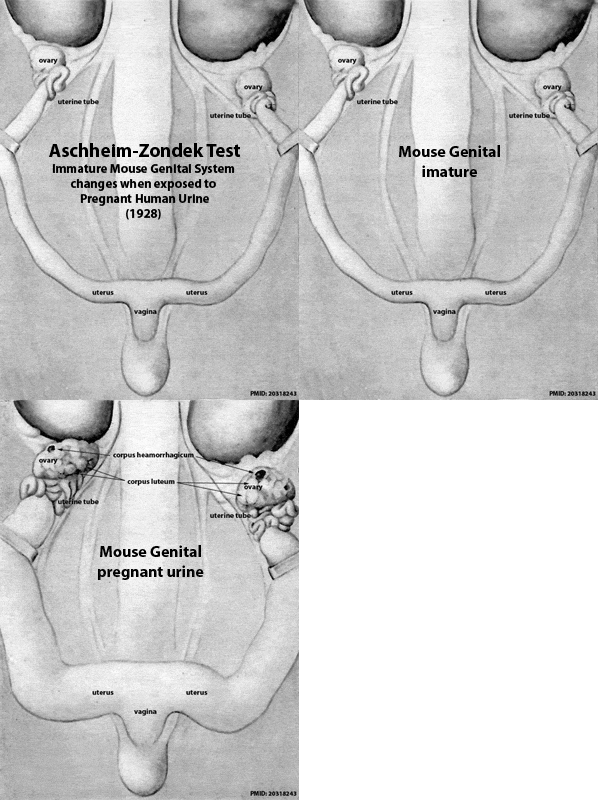
The basis of the original historic Aschheim-Zondek[1] test developed in 1928 was to identify the changes in immature female mouse genital system by female human urine injected subcutaneously into these immature mice.
- If the woman was pregnant - the presence of hormones (hCG) induced changes in the mouse genital tract physiologically similar to those produced by sex hormones.
- follicle maturation, corpora heamorrhagicum and corpora lutea formation.
- If the woman was not pregnant - there were no changes induced.
This early mouse test was later replaced with a similar, but simpler, urine test using the Xenopus frog.
Animation based upon original line drawings.[2]
- Links: Small Animation | Large Animation | Pregnancy Test | Menstrual Cycle | Week 2 | Mouse Development | Frog Development
Reference
File history
Yi efo/eka'e gwa ebo wo le nyangagi wuncin ye kamina wunga tinya nan
| Gwalagizhi | Nyangagi | Dimensions | User | Comment | |
|---|---|---|---|---|---|
| current | 11:16, 15 November 2012 | | 299 × 400 (82 KB) | Z8600021 (talk | contribs) | ==Aschheim-Zondek Test (1928)== The basis of the original historic Aschheim-Zondek<ref>Aschheim, S., and Zondek, B., Klin. Wschr., 7 8, 1401 (1928).</ref> test developed in 1928 was to identify the changes in immature female mouse genital system by female |
You cannot overwrite this file.
File usage
The following page uses this file:


