Talk:Draft 2016

From Embryology

Blood Cells

Blood Cell Development
Hematopoietic and stromal cell differentiation.jpg
Two Blood Cell Systems
  1. Mononuclear Phagocytic System - circulating monocytes of peripheral blood and non-circulating (fixed) tissue macrophages found throughout the body.
  2. Lymphoid System - lymphocytes, three major types of T, B, and NK.


Lymphoid Organs

  • Central - (primary) Lymphocytes develop from precursor cells in bone marrow and thymus. (see blood marrow image)
  • Peripheral - (secondary) Lymphocytes respond to antigen lymph nodes or spleen.
Blood Cells
The blood cell information shown below in the table is shown to identify the relative proportions of different cell types in the circulating blood. This information is provided in the lecture as additional information for reference purposes only.

Blood Cell Numbers

The adult ranges of cells / 1 litre (l), total blood volume is about 4.7 to 5 litres. Blood Development | Blood Histology

Red Blood Cells

  • Male: 4.32 - 5.66 x 10¹²/l
  • Female: 3.88 - 4.99 x 10¹²/l

Leukocytes (white blood cells)

  • Male: 3.7 - 9.5 x 10⁹/l
  • Female: 3.9 - 11.1 x 10⁹/l

Granulocytes

  • 1.8 - 8.9 x 10⁹/l
    • Neutrophils: 1.5 - 7.4 x 10⁹/l
    • Eosinophils: 0.02 - 0.67 x 10⁹/l
    • Basophils: 0 - 0.13 x 10⁹/l

Non-Granulocytes

  • Monocytes 0.21 - 0.92 x 10⁹/l

Lymphocytes

  • 1.1 - 3.5 x 10⁹/l
    • B-cells: 0.06 - 0.66 x 10⁹/l
    • T-cells: 0.77 - 2.68 x 10⁹/l
      • CD4+: 0.53 - 1.76 x 10⁹/l
      • CD8+: 0.30 - 1.03 x 10⁹/l
    • NK cells: 0.20 - 0.40 x 10⁹/l

Platelets

  • 140 - 440 x 109/l
    • not a cell, a cell fragment.
1. Mononuclear Phagocytic System 
Mononuclear Phagocytic System (MPS, also called Lymphoreticular System or Reticuloendothelial System, RES)
Monocyte 01.jpg Liver- Kupffer cell and reticular fibre.jpg
Circulating monocytes of peripheral blood.
  • monocytes entering the connective tissue differentiate into macrophages)
Non-circulating (fixed) tissue macrophages (MΦ)
2. Lymphoid System 
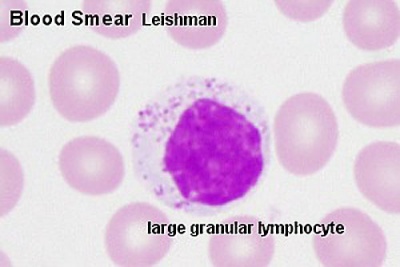
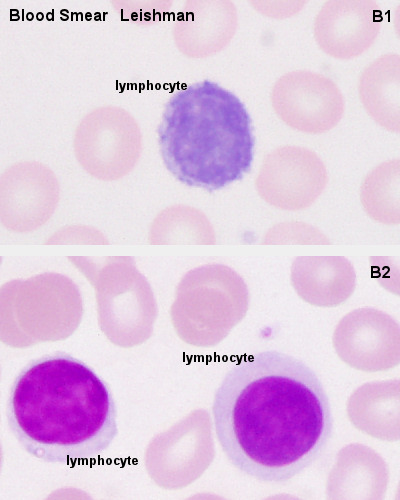
Adaptive immunity functional cells are the lymphocytes (B, T, NK) and dendritic cells (process antigen and present it on their surface, monocyte precursor derived).
  1. Antibody-mediated - B Lymphocyte secreting antibody = Plasma Cell
  2. Cell-mediated - T Lymphocytes form memory cell, Cytotoxic T cells, T helper cell

Lymphocyte 01.jpg Lymphocyte 02.jpg

B Cell Development Germinal Centres
  • Bone marrow
  • blood
  • Lymph node, nodule
  • Lymphatic vessel
  • Bone marrow
  • Bone Marrow
  • Medullary cords contain plasma cells
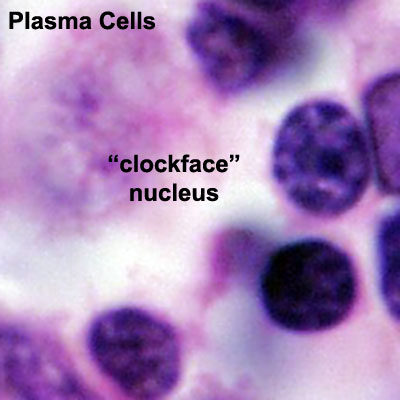
Plasma cell clockface nucleus 01.jpg Plasma cells
  • Activated B cell, plasma B cells, plasmocytes, effector B cells and B cell that is secreting antibody.
  • secrete antibody directly into blood for distribution to all body
  • in local extrafollicular sites are short lived 2–4 days
  • longer-lived plasma cells in bone marrow 3 weeks to 3 months+
  • "clockface" nucleus
    • Nucleus has darker (heterochromatin) regions around periphery of nucleus separated by lighter (euchromatin) regions.


Lymphocyte Electron Micrographs
Histologically, there is little difference in appearance between T and B lymphocytes until activated.

Lymphocyte Circulation

  • Microbial antigens are carried into a lymph node by dendritic cells, which enter via afferent lymphatic vessels draining an infected tissue.
  • T and B cells enter the lymph node via an artery and migrate out of the bloodstream through postcapillary venules.
    • Unless they encounter their antigen, the T and B cells leave the lymph node via efferent lymphatic vessels, which eventually join the thoracic duct.
  • The thoracic duct empties into a large vein carrying blood to the heart.
  • A typical circulation cycle takes about 12–24 hours.


Links: MBoC Chapter 24 - The Adaptive Immune System | MBoC Figure 24-14. The path followed by lymphocytes as they continuously circulate between the lymph and blood | Immunobiology