File:Mouse-pancreas duct formation.jpg
Original file (1,000 × 709 pixels, file size: 154 KB, MIME type: image/jpeg)
Development and banching morphogenesis of the pancreas
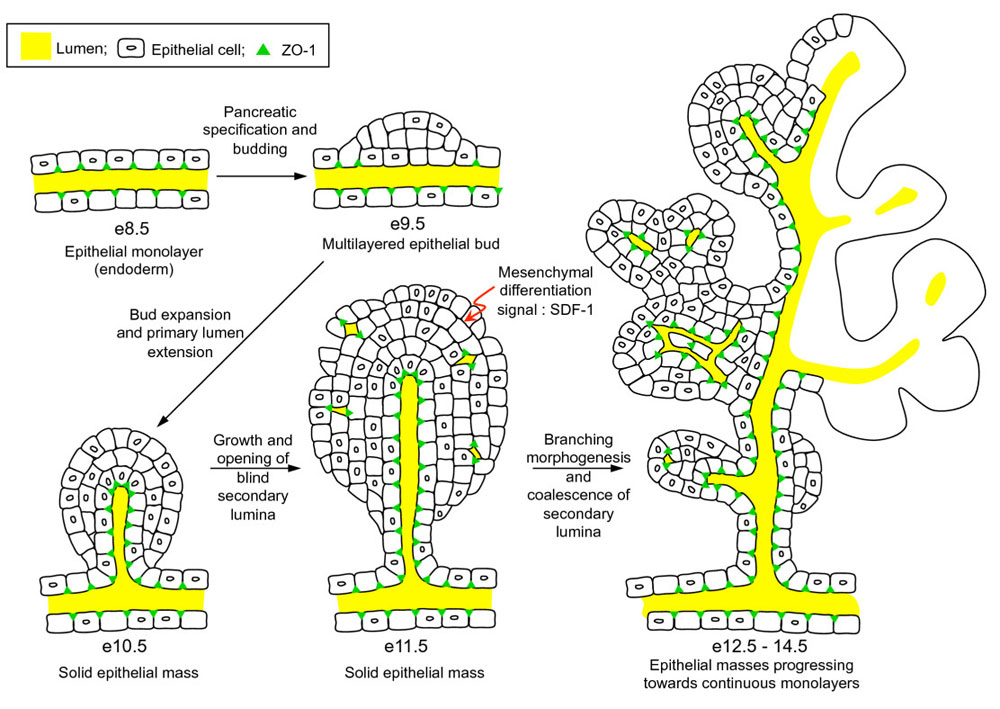
Pancreatic specification of polarized endodermal cells leads to the formation of a multilayered and then globular mass of epithelial cells with a central duct lumen (pancreatic bud). This lumen, connected to the gut tube lumen, forms extensions within the pancreatic bud, and is surrounded by several layers of cells, linked by adherens junctions (E-cadherin), but lacking tight junctions (ZO-1). Around mouse embryo e11.5, before remodeling of the mass, some cells at the periphery acquire apico-basal polarity and delineate blind lumina (secondary lumina). Initial branching morphogenesis events result from the coalescence of secondary and central lumina, allowing the progression towards epithelial monolayers.
Hick et al. BMC Developmental Biology 2009 9:66 doi:10.1186/1471-213X-9-66
<pubmed>20003423</pubmed>
http://www.biomedcentral.com/1471-213X/9/66
© 2009 Hick et al; licensee BioMed Central Ltd.
This is an Open Access article distributed under the terms of the Creative Commons Attribution License (http://creativecommons.org/licenses/by/2.0), which permits unrestricted use, distribution, and reproduction in any medium, provided the original work is properly cited.
File history
Yi efo/eka'e gwa ebo wo le nyangagi wuncin ye kamina wunga tinya nan
| Gwalagizhi | Nyangagi | Dimensions | User | Comment | |
|---|---|---|---|---|---|
| current | 03:47, 18 April 2010 | | 1,000 × 709 (154 KB) | S8600021 (talk | contribs) | Development and banching morphogenesis of the pancreas. Pancreatic specification of polarized endodermal cells leads to the formation of a multilayered and then globular mass of epithelial cells with a central duct lumen (pancreatic bud). This lumen, co |
You cannot overwrite this file.


