File:Worm - male development.jpg: Difference between revisions
(==Male-specific structures develop postembryonically== (A) The larval male is almost indistinguishable from the hermaphrodite. The external male mating structures differentiate rapidly at the end of the last larval stage. (B) Ventral view of the adult m) |
No edit summary |
||
| Line 15: | Line 15: | ||
<pubmed>18050419</pubmed> | <pubmed>18050419</pubmed> | ||
[http://www.wormbook.org/chapters/www_maledevelopment/maledevelopment.html Worm Book - Male development] | [http://www.wormbook.org/chapters/www_maledevelopment/maledevelopment.html Worm Book - Male development] | ||
All WormBook content, except where otherwise noted, is licensed under a Creative Commons Attribution License. | |||
[[Category:Worm]] [[Category:Male]] | [[Category:Worm]] [[Category:Male]] | ||
Latest revision as of 06:12, 7 November 2010
Male-specific structures develop postembryonically
(A) The larval male is almost indistinguishable from the hermaphrodite. The external male mating structures differentiate rapidly at the end of the last larval stage.
(B) Ventral view of the adult male tail, Nomarski photomicrograph.
(C) Sagittal section through the adult male tail showing the three types of canals; reproductive, digestive, and spicule channel, that join at the proctodeal chamber.
- "The features that differentiate the C. elegans male from the hermaphrodite arise during postembryonic development. The major male mating structures, consisting of the blunt tail with fan and rays, the hook, the spicules and proctodeum, and the thin body, form just before the last larval molt. Male and hermaphrodite embryogenesis are similar but some essential male cell fates are already established at hatching. The male mating structures arise from three important sets of male-specific blast cells. These cells generate a total of 205 male-specific somatic cells, including 89 neurons, 36 neuronal support cells, 41 muscles, 23 cells involved in differentiating the hindgut, and 16 hypodermal cells associated with mating structures."
Original File Name: Figure 1. Maledevfig1_s.jpg
Reference
<pubmed>18050419</pubmed> Worm Book - Male development
All WormBook content, except where otherwise noted, is licensed under a Creative Commons Attribution License.
File history
Yi efo/eka'e gwa ebo wo le nyangagi wuncin ye kamina wunga tinya nan
| Gwalagizhi | Nyangagi | Dimensions | User | Comment | |
|---|---|---|---|---|---|
| current | 06:11, 7 November 2010 | 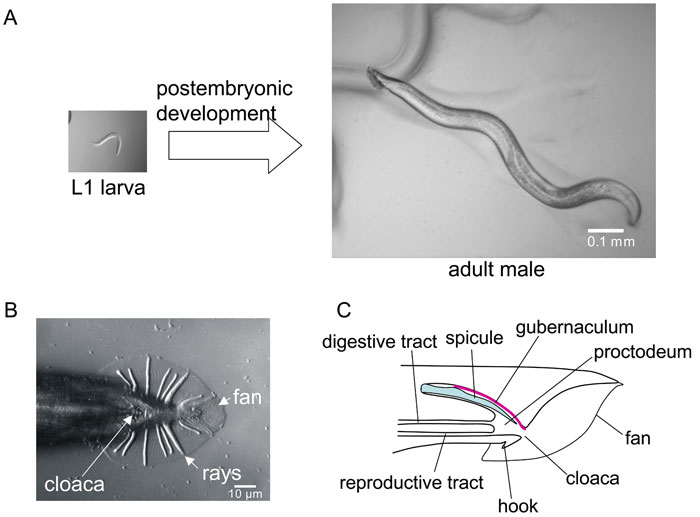 | 700 × 517 (44 KB) | S8600021 (talk | contribs) | ==Male-specific structures develop postembryonically== (A) The larval male is almost indistinguishable from the hermaphrodite. The external male mating structures differentiate rapidly at the end of the last larval stage. (B) Ventral view of the adult m |
You cannot overwrite this file.
File usage
The following page uses this file:


