Template:Pituitary Vignette: Difference between revisions
From Embryology
mNo edit summary |
mNo edit summary |
||
| Line 3: | Line 3: | ||
| [[Historic Embryology Vignette|'''Historic Embryology''']] | | [[Historic Embryology Vignette|'''Historic Embryology''']] | ||
|-bgcolor="FAF5FF" | |-bgcolor="FAF5FF" | ||
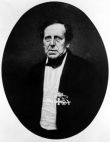
| width=125px|[[File:Martin Rathke.jpg|110px|alt=Martin Heinrich Rathke (1793 – 1860)|link=History_-_Embryologists#Martin_Heinrich_Rathke_.281793_-_1860.29]] | | width=125px|[[File:Martin Rathke.jpg|110px|left|alt=Martin Heinrich Rathke (1793 – 1860)|link=History_-_Embryologists#Martin_Heinrich_Rathke_.281793_-_1860.29]]During {{Pituitary}} development, the boundary surface {{ectoderm}} {{placode}} epithelium on the roof of the pharynx forms a transient epithelial pocket (Rathke's pouch) that comes into contact with the ectoderm of developing brain. | ||
<br> | <br> | ||
Rathke's pouch is named after the German embryologist and anatomist [[History_-_Embryologists#Martin_Heinrich_Rathke_.281793_-_1860.29|Martin Heinrich Rathke]] (1793 -1860). | Rathke's pouch is named after the German embryologist and anatomist [[History_-_Embryologists#Martin_Heinrich_Rathke_.281793_-_1860.29|Martin Heinrich Rathke]] (1793 -1860). | ||
|}<noinclude>[[Category:Historic Embryology]][[Category:Pituitary]]</noinclude> | |}<noinclude>[[Category:Historic Embryology]][[Category:Pituitary]]</noinclude> | ||
Revision as of 17:36, 6 February 2020
| Historic Embryology |
|
