File:XXhpgaxis.jpg: Difference between revisions
From Embryology
| Line 1: | Line 1: | ||
==The Female Endocrine Hypothalamic–Pituitary–Gonadal (HPG) Axis== | ==The Female Endocrine Hypothalamic–Pituitary–Gonadal (HPG) Axis== | ||
The hypothalamus produces and secretes gonadotrophin-releasing hormone (GnRH) into a system of blood vessels that link the hypothalamus and the pituitary gland. GnRH stimulates the pituitary gland by attaching to specific molecules (i.e., receptors). | ===Hypothalamus=== | ||
* The hypothalamus produces and secretes gonadotrophin-releasing hormone (GnRH) into a system of blood vessels that link the hypothalamus and the pituitary gland. | |||
* GnRH stimulates the pituitary gland by attaching to specific molecules (i.e., receptors). | |||
After the coupling of GnRH with these receptors, a cascade of biochemical events causes the pituitary gland to produce and secrete two hormones, luteinizing hormone (LH) and follicle–stimulating hormone (FSH). LH and FSH are two of a class of hormones commonly known as gonadotropins. | ===Pituitary=== | ||
* After the coupling of GnRH with these receptors, a cascade of biochemical events causes the pituitary gland to produce and secrete two hormones, luteinizing hormone (LH) and follicle–stimulating hormone (FSH). | |||
* LH and FSH are two of a class of hormones commonly known as gonadotropins. They are secreted into the general vascular circulation and attach to receptors on the ovary. | |||
===Ovary=== | |||
* LH and FSH in the general circulation attach to receptors on the ovary. | |||
* They trigger ovulation and stimulate ovarian production of the hormones estrogen and progesterone. | |||
* These female hormones cause monthly menstrual cycling and have multiple effects throughout the body. | |||
* In particular, estrogen has profound effects on the skeletal system and is crucial to maintaining normal bone health (Kanis 1994). | |||
Original file name: Figure 1 http://pubs.niaaa.nih.gov/publications/arh26-4/274-281.htm (gonadotrophin-releasing hormone was labeled LHRH, luteinizing hormone–releasing hormone in this original figure) | Original file name: Figure 1 http://pubs.niaaa.nih.gov/publications/arh26-4/274-281.htm (gonadotrophin-releasing hormone was labeled LHRH, luteinizing hormone–releasing hormone in this original figure) | ||
===Reference=== | ===Reference=== | ||
Revision as of 12:43, 9 September 2011
The Female Endocrine Hypothalamic–Pituitary–Gonadal (HPG) Axis
Hypothalamus
- The hypothalamus produces and secretes gonadotrophin-releasing hormone (GnRH) into a system of blood vessels that link the hypothalamus and the pituitary gland.
- GnRH stimulates the pituitary gland by attaching to specific molecules (i.e., receptors).
Pituitary
- After the coupling of GnRH with these receptors, a cascade of biochemical events causes the pituitary gland to produce and secrete two hormones, luteinizing hormone (LH) and follicle–stimulating hormone (FSH).
- LH and FSH are two of a class of hormones commonly known as gonadotropins. They are secreted into the general vascular circulation and attach to receptors on the ovary.
Ovary
- LH and FSH in the general circulation attach to receptors on the ovary.
- They trigger ovulation and stimulate ovarian production of the hormones estrogen and progesterone.
- These female hormones cause monthly menstrual cycling and have multiple effects throughout the body.
- In particular, estrogen has profound effects on the skeletal system and is crucial to maintaining normal bone health (Kanis 1994).
Original file name: Figure 1 http://pubs.niaaa.nih.gov/publications/arh26-4/274-281.htm (gonadotrophin-releasing hormone was labeled LHRH, luteinizing hormone–releasing hormone in this original figure)
Reference
<pubmed>12875037</pubmed>| NIAAA
Copyright Information - Most of the information available on the NIAAA Web site is within the public domain, and unless otherwise noted, may be freely downloaded and reproduced. Citation of the source is appreciated.
File history
Yi efo/eka'e gwa ebo wo le nyangagi wuncin ye kamina wunga tinya nan
| Gwalagizhi | Nyangagi | Dimensions | User | Comment | |
|---|---|---|---|---|---|
| current | 14:04, 20 Mayıs 2011 | 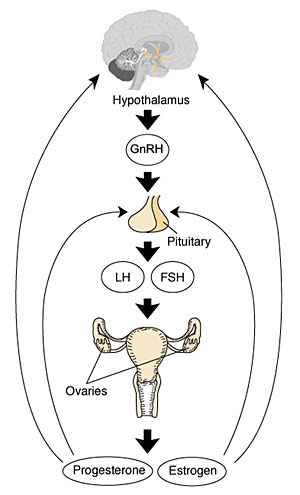 | 300 × 495 (24 KB) | S8600021 (talk | contribs) | Changed LHRH to GnRH |
| 15:28, 21 April 2010 |  | 300 × 495 (24 KB) | S8600021 (talk | contribs) | The female endocrine Hypothalamic–Pituitary–Gonadal (HPG) axis. The hypothalamus produces and secretes luteinizing hormone–releasing hormone (LHRH) into a system of blood vessels that link the hypothalamus and the pituitary gland. LHRH stimulates |
You cannot overwrite this file.
File usage
The following 10 pages use this file:
- 2010 Foundations Lecture - Introduction to Human Development
- BGDA Lecture - Development of the Embryo/Fetus 1
- BGD Lecture - Sexual Differentiation
- Endocrine - Gonad Development
- Endocrine - Hypothalamus Development
- Foundations Lecture - Introduction to Human Development
- Lecture - Fertilization
- Lecture - Genital Development
- Menstrual Cycle
- Pre-Medicine Program - Embryology


