File:Sea Urchin-endomesoderm induction.png: Difference between revisions
No edit summary |
|||
| Line 1: | Line 1: | ||
Gene Regulatory Networks Underlying Endomesoderm Induction | ==Gene Regulatory Networks Underlying Endomesoderm Induction== | ||
(B) Schematic depicting an experiment that reveals micromere-derived endomesoderm inductive signals, which are sufficient to induce ectopic endo16 expression and complete archenteron formation in animal blastomeres, and are also necessary for normal vegetal endo16 expression and timely gastrulation in the sea urchin embryo. The regulatory interactions among these signals and the overall EM-GRN are unknown. GRN diagram is adapted from [8]. | '''(A)''' The micromere determinant Pmar1 (circled in red) activates the PMC-GRN in micromere progeny and is sufficient for micromere-derived endomesoderm-inducing signals. The E-EM/En-GRNs (up to 17 h postfertilization) integrate the regulatory functions of maternal and zygotic core factors that drive the earliest steps of endomesoderm progenitor specification in sea urchin embryos. The zygotically expressed core factors Z13, Eve, Wnt8, Blimp1, FoxA, and Brachyury (Bra) (circled in black) accumulate in presumptive endomesoderm during early developmental stages and could potentially respond to early inductive inputs from micromere descendants. | ||
'''(B)''' Schematic depicting an experiment that reveals micromere-derived endomesoderm inductive signals, which are sufficient to induce ectopic endo16 expression and complete archenteron formation in animal blastomeres, and are also necessary for normal vegetal endo16 expression and timely gastrulation in the sea urchin embryo. The regulatory interactions among these signals and the overall EM-GRN are unknown. GRN diagram is adapted from [8]. | |||
doi:10.1371/journal.pbio.1000029.g001 | doi:10.1371/journal.pbio.1000029.g001 | ||
Original file name: Journal.pbio.1000029.g001.png | Original file name: Journal.pbio.1000029.g001.png | ||
'''See also:''' [http://www.nottingham.ac.uk/~plzloose/mygrn/index.php myGRN] myGRN: a database and visualisation system for the storage and analysis of developmental genetic regulatory networks http://www.ncbi.nlm.nih.gov/pubmed/19500400 | |||
==Reference== | ==Reference== | ||
Revision as of 14:16, 12 October 2010
Gene Regulatory Networks Underlying Endomesoderm Induction
(A) The micromere determinant Pmar1 (circled in red) activates the PMC-GRN in micromere progeny and is sufficient for micromere-derived endomesoderm-inducing signals. The E-EM/En-GRNs (up to 17 h postfertilization) integrate the regulatory functions of maternal and zygotic core factors that drive the earliest steps of endomesoderm progenitor specification in sea urchin embryos. The zygotically expressed core factors Z13, Eve, Wnt8, Blimp1, FoxA, and Brachyury (Bra) (circled in black) accumulate in presumptive endomesoderm during early developmental stages and could potentially respond to early inductive inputs from micromere descendants.
(B) Schematic depicting an experiment that reveals micromere-derived endomesoderm inductive signals, which are sufficient to induce ectopic endo16 expression and complete archenteron formation in animal blastomeres, and are also necessary for normal vegetal endo16 expression and timely gastrulation in the sea urchin embryo. The regulatory interactions among these signals and the overall EM-GRN are unknown. GRN diagram is adapted from [8].
doi:10.1371/journal.pbio.1000029.g001
Original file name: Journal.pbio.1000029.g001.png
See also: myGRN myGRN: a database and visualisation system for the storage and analysis of developmental genetic regulatory networks http://www.ncbi.nlm.nih.gov/pubmed/19500400
Reference
<pubmed>19192949</pubmed>| PLoS Biol.
Citation: Sethi AJ, Angerer RC, Angerer LM (2009) Gene Regulatory Network Interactions in Sea Urchin Endomesoderm Induction. PLoS Biol 7(2): e1000029. doi:10.1371/journal.pbio.1000029
This is an open-access article distributed under the terms of the Creative Commons Public Domain declaration which stipulates that, once placed in the public domain, this work may be freely reproduced, distributed, transmitted, modified, built upon, or otherwise used by anyone for any lawful purpose.
File history
Yi efo/eka'e gwa ebo wo le nyangagi wuncin ye kamina wunga tinya nan
| Gwalagizhi | Nyangagi | Dimensions | User | Comment | |
|---|---|---|---|---|---|
| current | 00:57, 29 March 2010 | 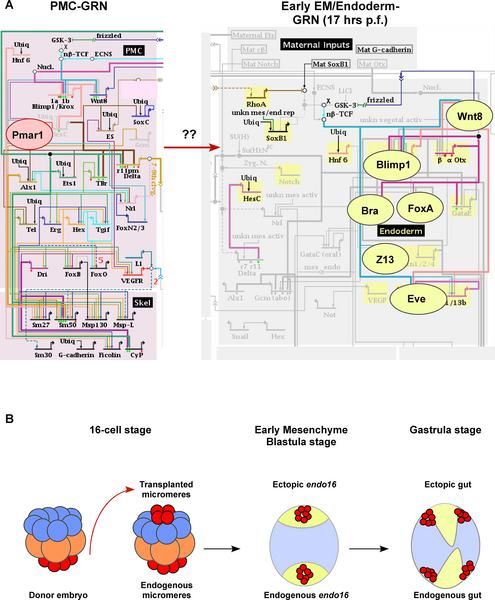 | 495 × 600 (194 KB) | S8600021 (talk | contribs) | Gene Regulatory Networks Underlying Endomesoderm Induction (A) The micromere determinant Pmar1 (circled in red) activates the PMC-GRN in micromere progeny and is sufficient for micromere-derived endomesoderm-inducing signals. The E-EM/En-GRNs (up to 17 h |
You cannot overwrite this file.
File usage
The following page uses this file:


