File:Obstruction implantation.png: Difference between revisions
(Implantation due to Fallopian Tube Obstruction Obstruction of the fallopian tubes is responsible for ~50% of tubal pregnancies. Any factor retarding the passage of the fertilized egg increases the risk of a tubal pregnancy, including previous ectopic p...) |
No edit summary |
||
| Line 1: | Line 1: | ||
Implantation due to Fallopian Tube Obstruction | == Implantation due to Fallopian Tube Obstruction == | ||
Obstruction of the fallopian tubes is responsible for ~50% of tubal pregnancies. Any factor retarding the passage of the fertilized egg increases the risk of a tubal pregnancy, including previous ectopic pregnancies within the fallopian tube. Implantation can occur at several different sites in the tubes, with the most common being in the ampulla of the fallopian tube, though the position of any impeding scar tissue plays a role. The remaining 50% of tubal pregnancies have no proven cause for incorrect implantation. Normal implantation positioning within the uterus is shown on the left-hand side of the image. | Obstruction of the fallopian tubes is responsible for ~50% of tubal pregnancies. Any factor retarding the passage of the fertilized egg increases the risk of a tubal pregnancy, including previous ectopic pregnancies within the fallopian tube. Implantation can occur at several different sites in the tubes, with the most common being in the ampulla of the fallopian tube, though the position of any impeding scar tissue plays a role. The remaining 50% of tubal pregnancies have no proven cause for incorrect implantation. | ||
Drawn and labelled by z3459191 | <br /> Normal implantation positioning within the uterus is shown on the left-hand side of the image. | ||
Beginning six months after publication, I, z3459191, grant the public the non-exclusive right to copy, distribute, or display the Work under a Creative Commons Attribution-Noncommercial-Share Alike 3.0 Unported license, as described at http://creativecommons.org/licenses/by-nc-sa/3.0/ and http://creativecommons.org/licenses/by-nc-sa/3.0/legalcode. | <br />Drawn and labelled by z3459191. | ||
<br /> Beginning six months after publication, I, z3459191, grant the public the non-exclusive right to copy, distribute, or display the Work under a Creative Commons Attribution-Noncommercial-Share Alike 3.0 Unported license, as described at http://creativecommons.org/licenses/by-nc-sa/3.0/ and http://creativecommons.org/licenses/by-nc-sa/3.0/legalcode. | |||
Latest revision as of 15:21, 26 July 2014
Implantation due to Fallopian Tube Obstruction
Obstruction of the fallopian tubes is responsible for ~50% of tubal pregnancies. Any factor retarding the passage of the fertilized egg increases the risk of a tubal pregnancy, including previous ectopic pregnancies within the fallopian tube. Implantation can occur at several different sites in the tubes, with the most common being in the ampulla of the fallopian tube, though the position of any impeding scar tissue plays a role. The remaining 50% of tubal pregnancies have no proven cause for incorrect implantation.
Normal implantation positioning within the uterus is shown on the left-hand side of the image.
Drawn and labelled by z3459191.
Beginning six months after publication, I, z3459191, grant the public the non-exclusive right to copy, distribute, or display the Work under a Creative Commons Attribution-Noncommercial-Share Alike 3.0 Unported license, as described at http://creativecommons.org/licenses/by-nc-sa/3.0/ and http://creativecommons.org/licenses/by-nc-sa/3.0/legalcode.
File history
Yi efo/eka'e gwa ebo wo le nyangagi wuncin ye kamina wunga tinya nan
| Gwalagizhi | Nyangagi | Dimensions | User | Comment | |
|---|---|---|---|---|---|
| current | 15:19, 26 July 2014 | 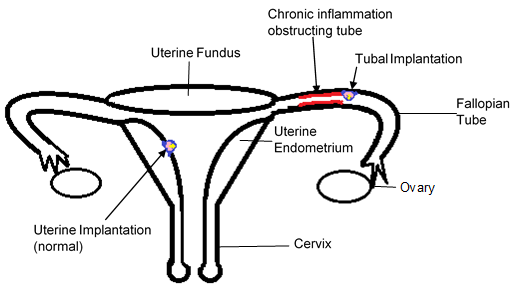 | 520 × 294 (32 KB) | Z3459191 (talk | contribs) | Implantation due to Fallopian Tube Obstruction Obstruction of the fallopian tubes is responsible for ~50% of tubal pregnancies. Any factor retarding the passage of the fertilized egg increases the risk of a tubal pregnancy, including previous ectopic p... |
You cannot overwrite this file.
File usage
There are no pages that use this file.


