|
Salı 29 September 2026
Introduction
Welcome to the Embryology education and research website now in the 28th year online! There are many ways to find specific topics. Click on the left image term, or use the menu items at the page top, or the search window.
Bookmark with: https://embryology.med.unsw.edu.au
|
|
|


Current number of topic pages 6,455
| 10 Popular Pages
|
|
OK these are not my rankings, but by you the viewer.
These are the top ten popular pages based upon page views.
I have excluded the Main page, student projects and undergraduate course pages. Note, this data has not been updated since 1 January 2016, when page visit logs were removed.
|
1 January 2016 (EST)
- Embryonic Development (399,216 views)
- Placenta Development (183,296 views)
- Timeline human development (154,106 views)
- Neural System Development (116,916 views)
- Mouse Development (115,361 views)
- Respiratory System Development (112,977 views)
- Placenta - Abnormalities (111,887 views)
- Implantation (111,620 views)
- Fetal Development (97,150 views)
- Chicken Development (89,201 views)
|
|
Start Here
This is the Main Page of the website, clicking the top lefthand icon or the menu item will always bring you to here.
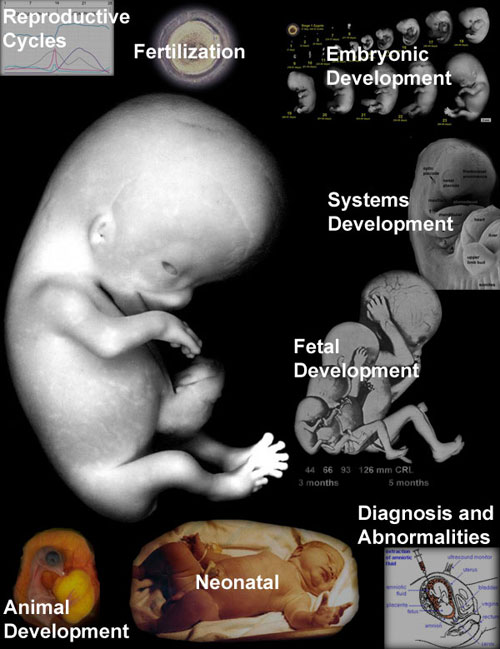
There are several different ways to find what you are looking for: click the major topic on the large left hand image, the Site Map also links to major topic sections, the Category option will show related materials, or simply use the search box.
| Embryology around the world (use the translate link by clicking Expand at the top of each page to change to your language) - embryologie (German, French, Dutch, Czech), embriología (Spanish, Italian, Portuguese), embryologi (Norwegian), embryologia (Finnish), embryoleg (Welsh), embriologi (Indonesian), embrayolohiya (Filipino), εμβρυολογία (Greek), эмбриология (Russian), 発生学 (Japanese), 胚胎 (Chinese), 발생학 (Korean), תוֹרַת הַעוּבָּר (Hebrew), علم الأجنة (Arabic), رویان شناسی (Persian), கருவியல் (Tamil), गर्भवृद्धिशास्त्र (Marathi), วิชาว่าด้วยระยะแรกเริม (Thai)
|
| Designed to update the original UNSW Embryology website online since 1996. You should find this new site easier to navigate and search. I am always happy to receive feedback on your learning experience.
Content has been derived under a number of different copyright restrictions, therefore do not assume that you can reuse content found on this current site without permission. Click on images and movies to get descriptions and full copyright information.
|
| News - Complete human day 14 post-implantation embryo models from naïve Embryonic Stem Cells
|
|
This recent Nature paper[1] describes the use of naïve human Embryonic Stem Cells to recapitulate the early stages of human development.
"The ability to study human post-implantation development remains limited due to ethical and technical challenges associated with intrauterine development after implantation....only genetically unmodified human naïve human ES cells...recapitulate the organization of nearly all known lineages and compartments of post-implantation human embryos including epiblast, hypoblast, extra-embryonic mesoderm, and trophoblast surrounding the latter layers...These human complete SEMs demonstrated developmental growth dynamics that resemble key hallmarks of post-implantation stage embryogenesis up to 13-14 days post-fertilization (dpf) (Carnegie stage 6a)."
- Links: stem cells | Carnegie stage 6
- ↑ Oldak B, Wildschutz E, Bondarenko V, Comar MY, Zhao C, Aguilera-Castrejon A, Tarazi S, Viukov S, Pham TXA, Ashouokhi S, Lokshtanov D, Roncato F, Ariel E, Rose M, Livnat N, Shani T, Joubran C, Cohen R, Addadi Y, Chemla M, Kedmi M, Keren-Shaul H, Pasque V, Petropoulos S, Lanner F, Novershtern N & Hanna JH. (2023). Complete human day 14 post-implantation embryo models from naïve ES cells. Nature , , . PMID: 37673118 DOI.
|
Glossary Links
- Glossary: A | B | C | D | E | F | G | H | I | J | K | L | M | N | O | P | Q | R | S | T | U | V | W | X | Y | Z | Numbers | Symbols | Term Link
Cite this page: Hill, M.A. (2026, September 29) Embryology Main Page. Retrieved from https://embryology.med.unsw.edu.au/embryology/index.php/Main_Page
- What Links Here?
- © Dr Mark Hill 2026, UNSW Embryology ISBN: 978 0 7334 2609 4 - UNSW CRICOS Provider Code No. 00098G
|